Starting Solids: The Complete First-Month Guide for New Parents
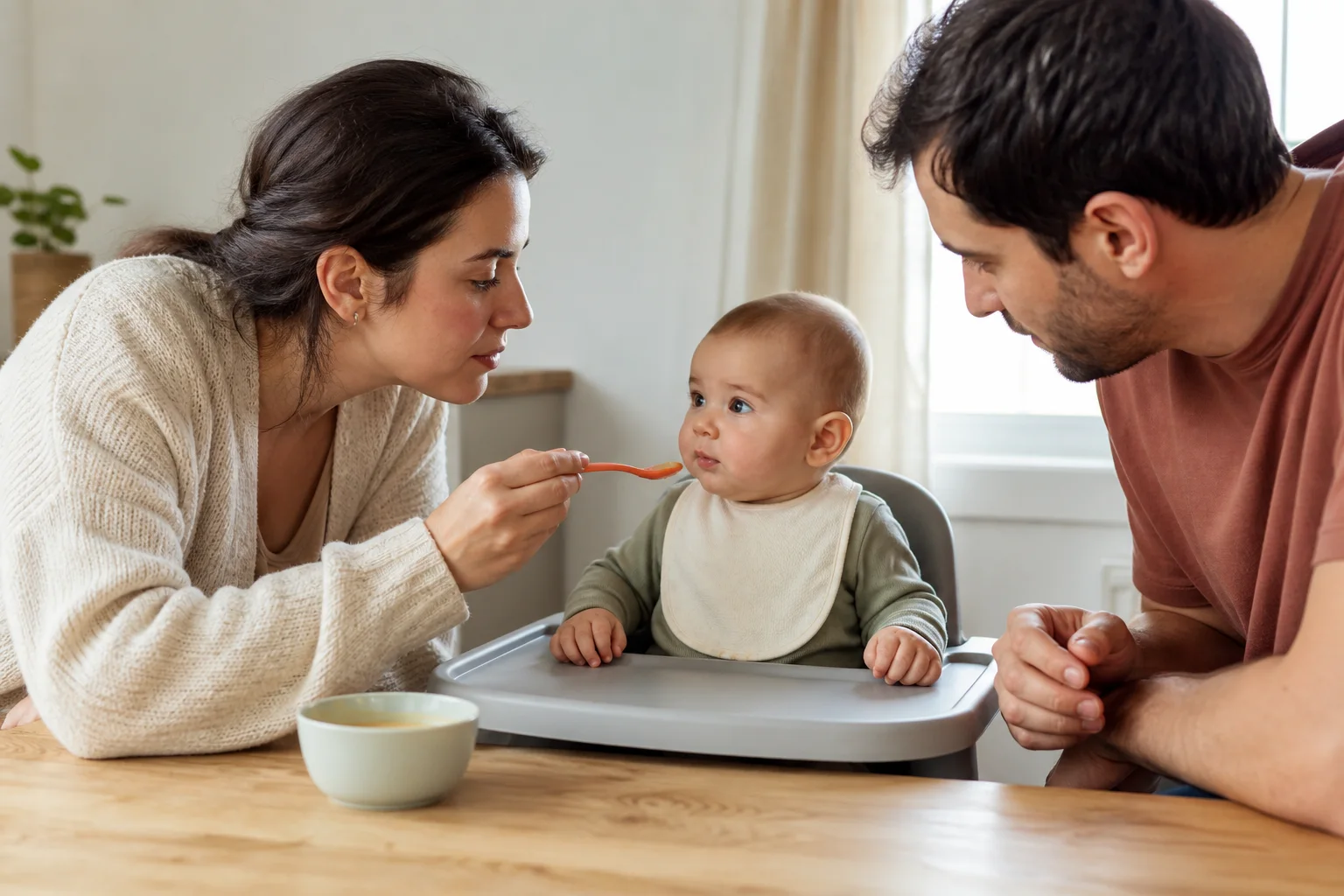
Your baby is staring at your fork. Your mother-in-law says "start rice cereal now." Your pediatrician said "around six months." And you have no idea what a first meal actually looks like. This guide walks you through the first month of solids, step by step, using the same guidance pediatricians follow.
SUMMARY
- When: around 6 months, when your baby shows the four readiness signs. Not before 4 months.
- What: single-ingredient purées, iron-rich first. One new food every 3 to 5 days.
- How much: 1 to 2 teaspoons, once a day. Breast milk or formula stays the main meal.
- Never before 12 months: honey, cow's milk as a drink, whole grapes or nuts, added salt or sugar.
When to start: around 6 months, and the four signs
Age alone is not the signal. The American Academy of Pediatrics and the CDC both point to around 6 months, and they add a second condition: your baby has to be physically ready. Starting before 4 months is not recommended. A baby's gut and swallowing reflexes are still maturing, and early solids do not help sleep, despite what you may have heard.
Look for these four signs together:
- Around 6 months old. Some babies are ready a little earlier, some a little later. Six months is the center, not a deadline.
- Holds their head steady. No wobbling when sitting upright. This protects the airway while swallowing.
- Sits with a little support. In a high chair or on your lap, upright and stable.
- Shows interest in your food. Reaches for it, opens their mouth when a spoon comes near, and no longer pushes food back out with the tongue.
All four? You are good to go. Not yet? Wait a week and check again. Nothing is lost by waiting a few days. Read the full readiness checklist.
What to feed first
There is no single "correct" first food. What matters is that each food is a single ingredient, smooth enough to swallow, and offered without salt or sugar. Because a baby's iron stores start to run low around 6 months, pediatricians suggest putting an iron-rich option early in the rotation.
| Good first foods | Why |
|---|---|
| Iron-fortified infant cereal (oat, barley, or rice) | Easy iron source, mixes thin with breast milk or formula |
| Puréed meat or lentils | Iron and protein |
| Mashed banana | Naturally soft, no cooking |
| Sweet potato or carrot purée | Mild, easy to make in batches |
| Mashed avocado | Healthy fat, no cooking |
The 3-day rule
Introduce one new food at a time and wait 3 to 5 days before adding the next one. If a rash, vomiting, diarrhea, or unusual fussiness shows up, you will know which food caused it. Once a food is cleared, you can keep it in the rotation and combine it with other cleared foods.
Allergens: earlier than you might think
Older advice said to delay peanut and egg. Current guidance is the opposite. Once your baby tolerates a few basic foods, common allergens such as smooth peanut butter thinned with water, well-cooked egg, and plain yogurt can be introduced around 6 months, one at a time. If your baby has severe eczema or a known egg allergy, talk to your pediatrician first. They may want the first taste to happen in the office. See the full first-foods list and a sample rotation.
How much and how often
Start with 1 to 2 teaspoons, once a day. That is not a typo. The first weeks are about learning to move food from the front of the mouth to the back and swallow, not about calories. Pick a time when your baby is alert and a little hungry but not starving, often 30 to 60 minutes after a milk feed.
Breast milk or formula is still the main source of nutrition for the whole first year. In the first weeks of solids, nearly all of your baby's calories still come from milk. Over the next few months, you will slowly increase to 2 and then 3 small meals a day while milk feeds continue.
Signs your baby has had enough: turning the head away, closing the mouth, pushing the spoon, or losing interest. Follow those cues. Do not try to finish the bowl. Read the portion guide with a week-by-week table.
Foods to skip before the first birthday
- Honey in any form, including baked goods. It can carry botulism spores that a baby's gut cannot handle before 12 months.
- Cow's milk as a drink. It lacks the right iron and nutrients for babies. Small amounts in cooking, yogurt, and cheese are fine after solids begin.
- Choking hazards: whole grapes, whole nuts, popcorn, hot dogs, hard raw vegetables, chunks of nut butter. Cut, mash, or thin them.
- Added salt and sugar. A baby's kidneys are small, and sugar builds a preference for sweet foods. Juice is not needed at all under 12 months.
See the complete list, including safer swaps.
What you actually need
Less than the baby aisle suggests. A high chair or a supported seat that keeps your baby upright, a small soft-tipped spoon, a bib, and a bowl. A cheap fork mashes a banana as well as any gadget. Save the blender for later, when you are making larger batches. Set the first meal at a table if you can. Babies watch you eat and copy the motion.
A sample first week
| Day | Offer | Notes |
|---|---|---|
| 1 to 3 | Iron-fortified oat cereal, 1 to 2 teaspoons, thinned | Same food three days in a row. Watch for reactions. |
| 4 to 6 | Sweet potato purée | Cereal can continue alongside. |
| 7 | Mashed banana | Two cleared foods, one new one. |

Keep a simple note on your phone: date, food, reaction. It takes ten seconds and saves a lot of guesswork if something comes up.
When to call your pediatrician
Call the same day if you see hives, swelling of the lips or face, vomiting, or trouble breathing after a new food. Trouble breathing is an emergency. Also bring it up at your next visit if your baby is gagging severely at every meal, refusing all solids past 7 months, or if you have any concern about weight gain. Your pediatrician knows your baby's history and can adjust this general guidance to fit.
Frequently asked questions
Can I start solids at 4 months?
Most pediatric guidance says wait until around 6 months and never before 4. If your baby is between 4 and 6 months and you think they are ready, ask your pediatrician rather than deciding alone.
Should I start with rice cereal?
You can, but you do not have to. Any iron-fortified infant cereal or an iron-rich purée works. Many pediatricians now suggest rotating grains rather than relying on rice alone.
My baby gags on everything. Is that normal?
Gagging is a normal protective reflex and looks dramatic. Choking is silent. If your baby gags, stays upright, and recovers, that is learning. If they cannot cough or make sound, that is an emergency.
Do I need to stop breastfeeding when solids start?
No. Breast milk or formula stays the main meal through the first year. Solids are added alongside, not instead.
Read next
- Is my baby ready for solid food? 4 signs to check
- Baby's first foods and the 3-day rule
- How much solid food should a 6-month-old eat?
- Foods to avoid before the first birthday
Sources
This article is general information for parents and is not medical advice. Every baby is different. Talk to your pediatrician about your baby's specific needs.