Is My Baby Ready for Solid Food? The 4 Signs to Check

"She's five months and she stares at everything I eat. Is that the sign?" It is a sign, but not enough on its own. Pediatricians look for four things together, and most first-time parents only know one of them.
SUMMARY
Your baby is ready for solids when all four are true: around 6 months old, holds their head steady, sits upright with a little support, and shows interest in food by reaching, opening their mouth for the spoon, and no longer pushing food out with the tongue. Three out of four means wait a week and check again. Never start before 4 months.
Why the age alone is not enough
The American Academy of Pediatrics, the CDC, and the WHO all point to around 6 months as the time to start solids. The reason is not a calendar. Around that age, a baby's iron stores start to run low, and their mouth and gut have matured enough to handle food that is not milk. Both things need to be true. A 6-month-old who cannot hold their head up is not ready. A 5-month-old who can do everything on the list may be close, but you should still check with your pediatrician before starting under 6 months.
The four signs, and how to check each one
1. Around 6 months old
This is the anchor. Some babies show the other signs a few weeks earlier, some a few weeks later. Six months is the center of the range, not a deadline you have to hit. If your baby was born early, count from the due date, not the birth date, and ask your pediatrician how to adjust.
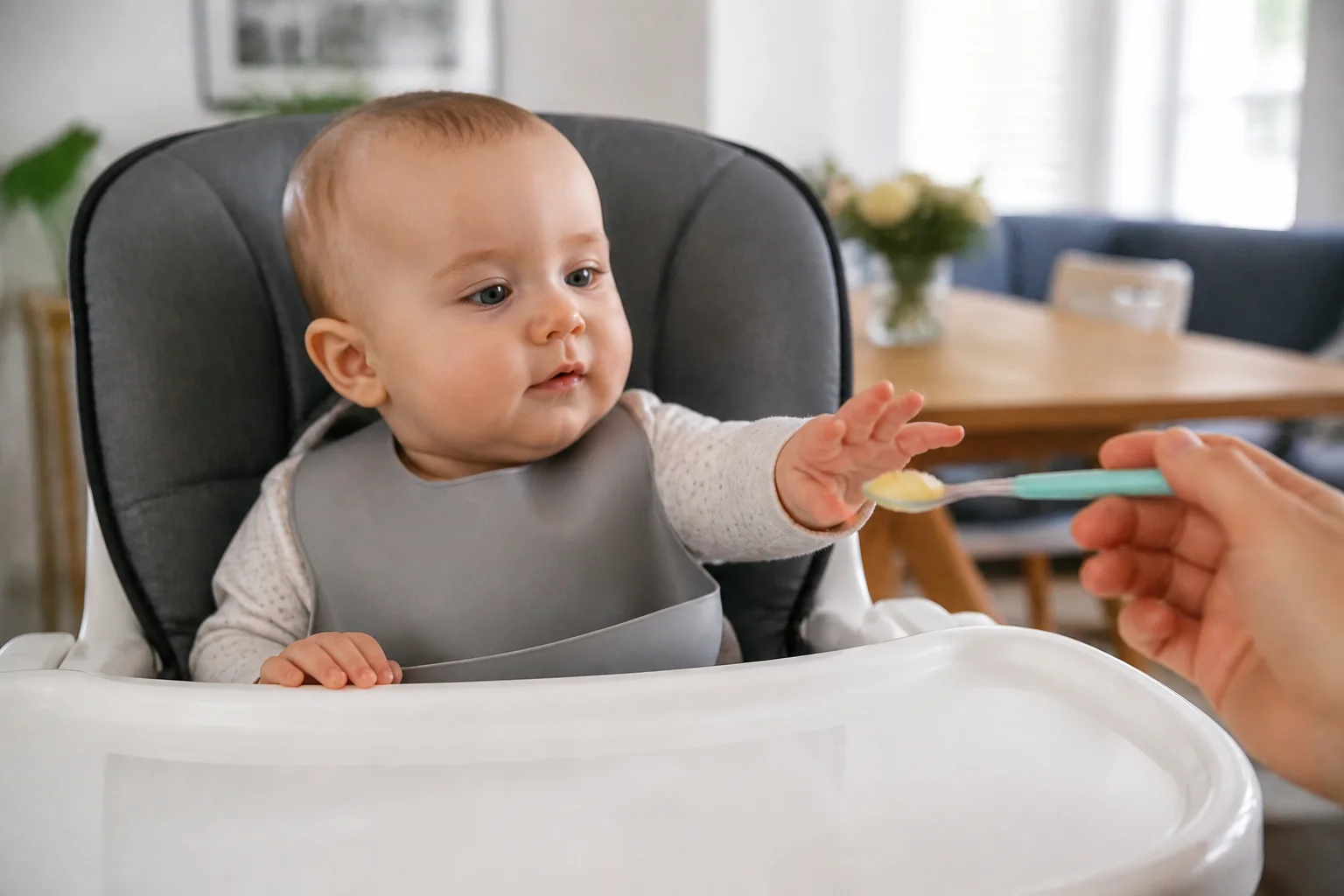
2. Holds their head steady
Sit your baby upright on your lap. Their head should stay level without bobbing or flopping. Steady head control protects the airway while swallowing. If the head wobbles, the swallow is not safe yet. Give it another week or two of tummy time and try again.
3. Sits upright with a little support
Your baby does not need to sit alone. They do need to sit upright in a high chair, or on your lap, without slumping sideways or forward. Slumping puts pressure on the throat and makes gagging more likely. If your high chair has a recline setting, keep it fully upright for meals.
4. Shows interest in food
This is the sign parents notice first, so it needs the most explanation. Watching you eat is normal curiosity and starts early. Real readiness looks like three things happening together: reaching for your food or plate, opening their mouth when a spoon comes near, and keeping food in the mouth instead of pushing it straight back out. That last one is the tongue-thrust reflex fading. If a tiny taste of purée comes right back out every time, the reflex is still active. Try again in a week.
Signs that do not mean "ready"
- Waking more at night. Sleep changes around 4 to 6 months are usually developmental, not hunger. Starting solids early does not fix them.
- Chewing on hands or toys. That is normal exploration and often teething.
- Wanting more milk. Growth spurts cause this. Offer more milk first.
- Reaching a certain weight. There is no weight cut-off in current guidance.
Three out of four: what to do
Wait. A week rarely changes anything except confidence. Re-check the missing sign in seven days. If your baby is past 6 months and one sign is still missing, especially head control or sitting, mention it at your next visit. It is usually nothing, but your pediatrician will want to know.
Between 4 and 6 months: the gray zone
Some pediatricians will suggest starting a little before 6 months for a specific reason, such as reflux or a family history of food allergy. That is a conversation to have with them, not a decision to make from a checklist. Starting before 4 months is not recommended by any major guideline. The gut and swallow are not ready, and early solids are linked to higher risk of choking and no benefit for sleep.
When to call your pediatrician
Call if your baby is past 7 months and still does not hold their head steady or sit with support, if they gag hard and turn red at every attempt, or if you are unsure whether they were born early enough to need an adjusted timeline. Your pediatrician can also tell you whether to start a little earlier for a medical reason.
Frequently asked questions
My baby is 6 months and shows no interest in food. Is something wrong?
Usually not. Keep offering a seat at the table and let them watch you eat. Interest often appears within a couple of weeks. If it has not by 7 months, mention it at your next visit.
Can I test readiness with a tiny taste?
Yes, once your baby is close to 6 months and has head control. A small taste of thin purée is a fair test of the tongue-thrust reflex. If it comes straight back out, wait a week.
Does teething mean they are ready?
No. Teeth are not needed for early solids, and teething often starts before or after readiness. Purées do not require chewing.
Ready to start? Read the full first-month guide to starting solids, or go straight to what to feed first.
Sources
This article is general information for parents and is not medical advice. Every baby is different. Talk to your pediatrician about your baby's specific needs.