Twin Care: Feeding, Sleep and a Routine

Build a flexible routine around each twin’s feeding cues, with a separate safe sleep space for each baby.
SUMMARY
- Follow each baby’s hunger cues.
- Share feeding, changing and settling tasks with another caregiver when available.
- Share your room with the babies for at least the first 6 months, while keeping their sleep spaces separate from your bed.
For caregivers of newborn twins and babies in their first months, start with a manageable feeding-and-rest rhythm.
Twins can differ in how much they feed and when they begin sleeping for longer stretches. Newborn twins, especially those born prematurely, need frequent feeds. For premature twins or feeding difficulties, ask the neonatal or feeding team about each baby’s feeding plan before changing the routine.
Choose a feeding setup you can manage
You do not have to settle on one method for every feed. Make the next feed workable for the adults available.
Sucking hands, searching for the breast or teat, and opening the mouth can be early hunger cues. Breastfeeding twins is possible; try comfortable positions and ask for help with attachment and positioning.
Feeding together is an option. So is feeding one at a time. You may combine breastfeeding and formula feeding, or use formula alone.

| Setup | How it works | When to ask for help |
|---|---|---|
| Breastfeeding | Comfortable positions, together or separately | Attachment, positioning or feeding concerns |
| Bottle feeding | An adult holds and attends to each baby | One baby seems to feed more or less than the other |
| Mixed feeding | Breastfeeds and formula as needed in your plan | Ask about either baby’s feeding concerns |
A very small or unwell premature baby may need expressed milk before direct breastfeeding is possible. If one twin is feeding noticeably more or less, or feeding worries you, contact your baby’s clinician or feeding support service.
Bottle feeds when two babies need you
For bottle feeds, hold the baby semi-upright with the head supported and keep the bottle almost horizontal. Allow pauses and stop when the baby shows they have had enough; do not force either twin to finish a bottle.
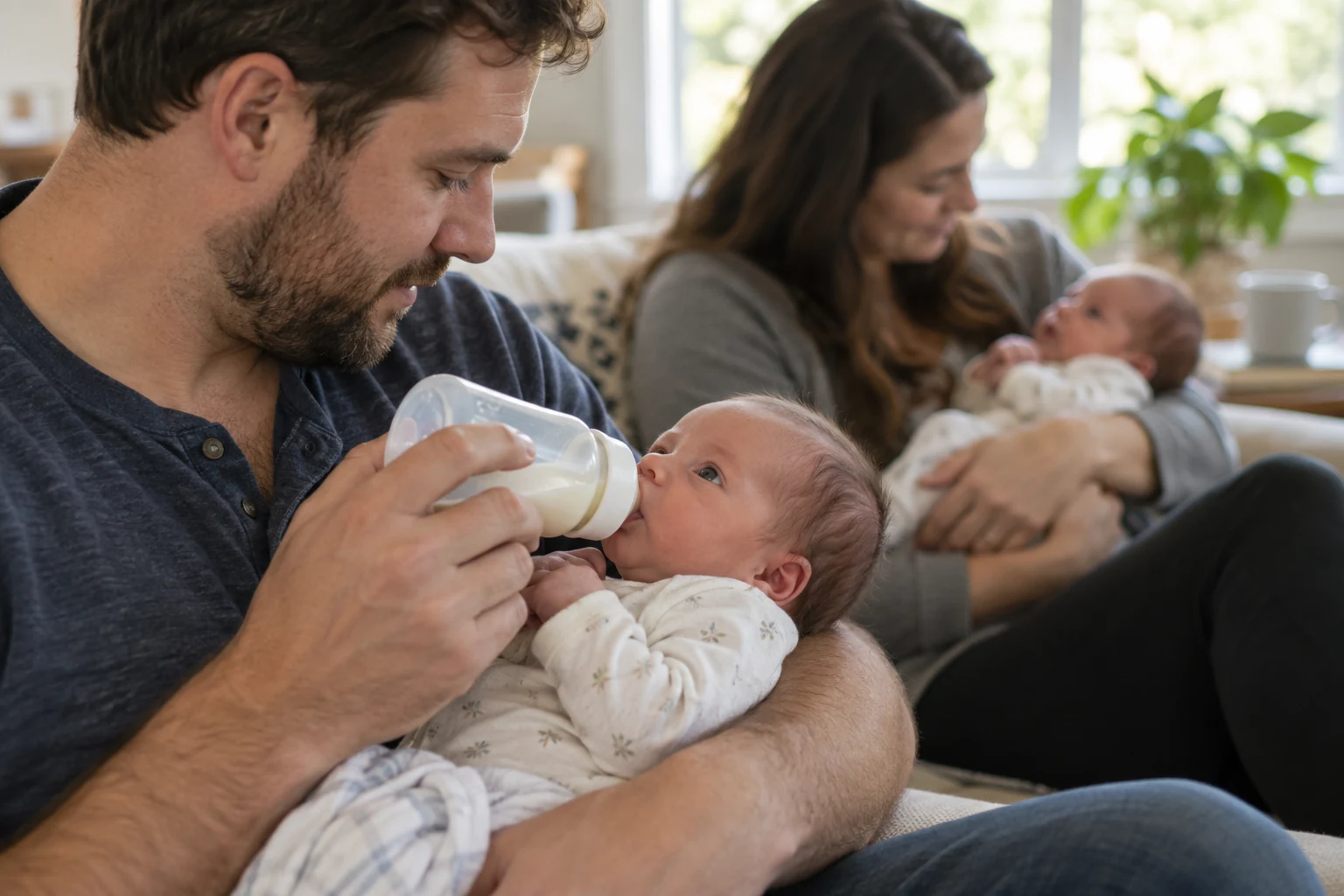
Never prop bottles. If you are feeding alone, feed one baby while the other waits in their own safe sleep space, rather than leaving either baby with a bottle. Prepare formula according to its instructions, keeping the specified water-to-powder ratio.
Two sleep spaces, one shared room
Use separate cribs for twins. Start every sleep on the back. Use a firm, flat infant mattress with only a fitted sheet, without pillows, loose blankets, toys or sleep positioners.

Share your room with the babies for at least the first 6 months, while keeping their sleep spaces separate from your bed. UK guidance allows small twins to share a cot under specified safe-sleep conditions, while US guidance recommends separate sleep areas for twins.
Before you sleep, return each baby to their own sleep space; avoid falling asleep with a baby on a sofa or armchair. A feeding pillow is not a sleep surface. A short, soothing bedtime routine may help the babies settle. One twin may sleep for longer at night before the other does.
A day organized around cues and handovers
Here is a flexible day plan. The anchors are events, so the plan can move with the babies instead of assigning a universal feeding interval.
| Part of the day | Care arrangement | Handover point |
|---|---|---|
| First feeds after waking | Available caregivers divide feeds and diaper changes. | Confirm which baby has already fed. |
| Daytime | Offer feeds in response to each baby’s cues. | If someone takes over, pass on feeding concerns. |
| Before bedtime | Repeat a calm settling sequence; return babies to their cribs. | Agree who answers the next waking. |
| Overnight | Respond to feeding needs; follow any baby-specific clinical plan. | Pass on the last feed and the next task. |

At handover, identify each baby and share the last feed, any feeding concern and the next caregiver’s task.
An example handover: “Alex has just finished a feed. Sam is showing hunger cues. You take Sam’s feed; I will handle Alex’s diaper.” Use your babies’ names and the actual situation.
When one baby needs help
Get urgent medical advice if a baby is not feeding or has fewer wet diapers than usual. If a baby younger than 3 months has a temperature of 38°C or higher, call emergency services or go to an emergency department immediately. Call emergency services or go to an emergency department immediately if a baby has difficulty breathing, blue or grey lips or skin, or is difficult to wake or will not wake.

As the babies grow
Around 6 months, one twin may be ready for solids before the other; ask your health professional about timing if they were born prematurely.
Questions about keeping twins in step
Do I have to feed both twins at the same time?
Feeding together is an option. So is feeding one at a time.
Will an extra-large evening bottle help both twins sleep?
A bigger feed does not guarantee a longer stretch of sleep.
What if I am doing all the care alone?
If you are caring for twins alone, ask a trusted friend or relative for practical help so you can rest.
Sources
- NHS — Feeding twins and multiples
- NHS — Twins and sleep
- American Academy of Pediatrics — HealthyChildren.org — How to Keep Your Sleeping Baby Safe: AAP Policy Explained
- NHS — When to get urgent medical help for babies and children under 5
- NIH — NICHD — Sudden Infant Death Syndrome (SIDS) and Other Sleep-Related Causes of Infant Death: Questions and Answers for Health Care Providers