Baby Flat Head: Correction and Helmet Therapy

Care for a baby’s flat head starts with safe positioning and assessment, with a helmet considered when appropriate.
SUMMARY
- Ask your pediatrician about flattening.
- Never use head-shaping pillows for sleep.
- Try tummy time, awake and supervised.
Is it plagiocephaly or brachycephaly?
Sustained pressure on a soft infant skull can cause positional flattening; prematurity, crowding before birth and a preference for looking one way can contribute.
| Head shape | Typical appearance |
|---|---|
| Plagiocephaly | Positional plagiocephaly means flattening on one side of the back of the head, sometimes with uneven ears or facial asymmetry. |
| Brachycephaly | Brachycephaly means a flatter back of the head with a wider overall shape; it can occur together with plagiocephaly. |
Torticollis is tightness in neck muscles that can limit turning and keep pressure on the same part of the head.

Sleep safety comes first
Start every sleep on the back.
This back-sleeping recommendation applies until age 1 year; do not start sleep on the side or tummy to reshape the head.
Use a firm, flat, level infant sleep surface with only a fitted sheet, without pillows, positioners, loose blankets or toys.
Change the pressure during awake time
Tummy time means awake play on the tummy with an adult watching; regular practice helps neck strength and head control.

During awake play, place your face or a toy toward the side your baby looks at less to encourage active head turning.
Vary the side you use for feeding and carrying your baby.

Avoid long unnecessary stretches in car seats, strollers or infant seats, and give your awake baby opportunities to move and be held.
When to get a head-shape assessment
A head that always tilts, difficulty turning the neck, or flattening that is worsening needs clinical assessment.
A clinician checks head shape, neck movement, head growth and development, and looks for signs of craniosynostosis, an early fusion of skull sutures.
A ridge along a skull suture or a head shape that does not improve can raise concern for craniosynostosis and should be assessed.
If craniosynostosis is suspected, urgent referral to a craniofacial specialist is needed rather than waiting for repositioning to work.
Routine X-rays or CT scans are not required to confirm positional plagiocephaly or brachycephaly; a specialist decides on imaging when craniosynostosis is suspected.
If neck tightness is present, a pediatric physiotherapist can teach appropriate handling and specific exercises and monitor improvement.

Does my baby need a helmet?
Mild positional flattening often improves with growth and changes in awake-time positioning; helmets are considered for selected babies with persistent moderate or severe flattening.
A custom helmet guides growth by leaving space over flatter areas; it is prescribed and fitted after an assessment.
In US guidance, helmet therapy may be considered for persistent moderate or severe positional flattening after repositioning or physical therapy, especially in older infants.
In Australian guidance, around 6–7 months is an optimal helmet-treatment window for suitable babies, but local criteria vary.
An older baby may still be assessed for a helmet, although later starts can mean longer treatment.
In the UK, helmets and headbands for flat head syndrome are not available on the NHS because evidence of benefit is insufficient.
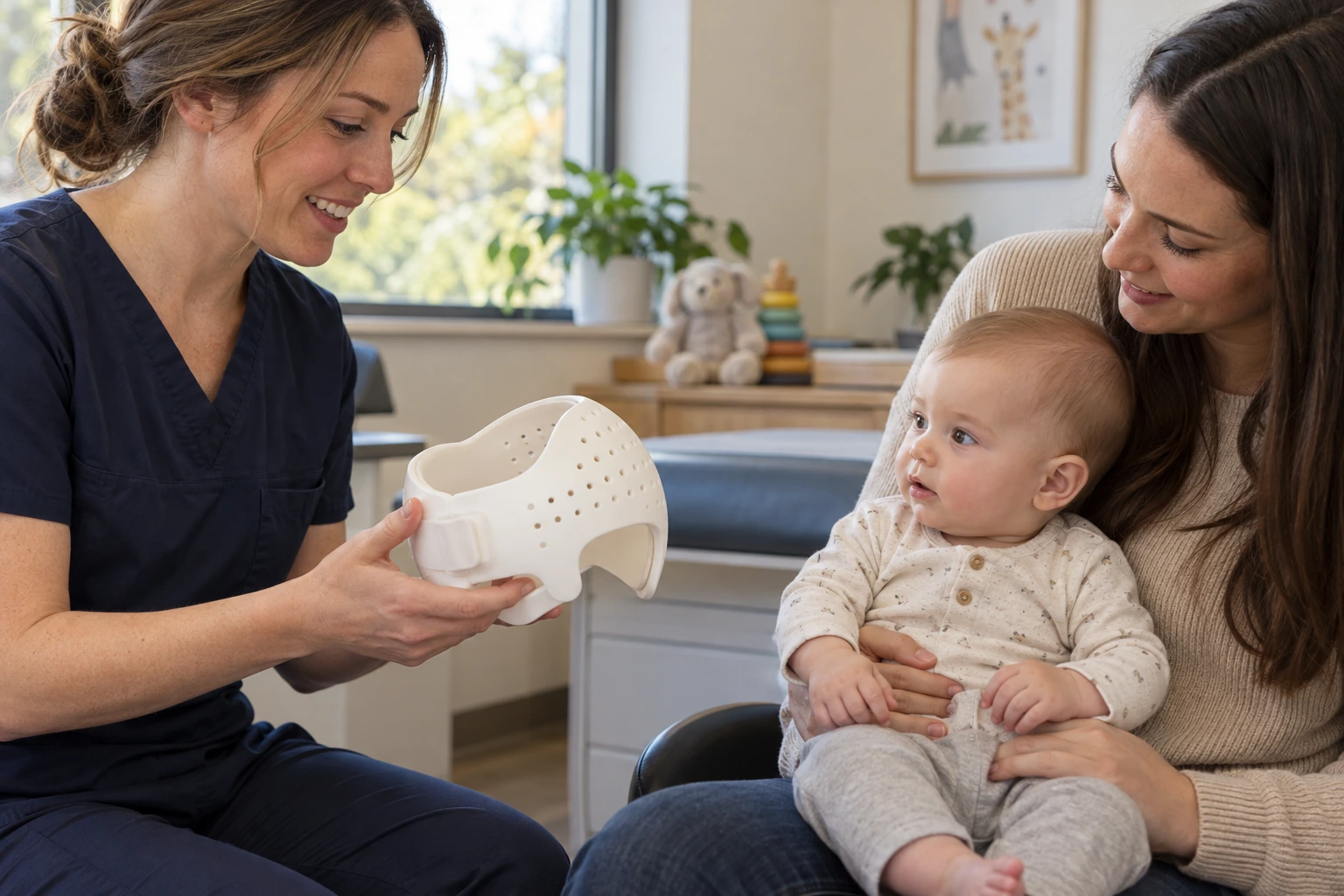
Even with a helmet, some head-shape difference may remain.
Helmets are commonly worn about 23 hours a day for several months, with progress and fit checked by the treating team.
Skin irritation, discomfort or an unpleasant smell during treatment should prompt contact with the helmet specialist for a fit check and adjustment.
What improvement can you expect?
Most positional flattening improves as babies grow and spend less time resting on the back of the head, often over the first 1–2 years.
An association between plagiocephaly and developmental delay does not prove that flattening causes the delay; developmental concerns still deserve assessment.
Questions parents still ask
What if my baby rolls during sleep?
If your baby can roll both from back to tummy and from tummy to back independently, you can leave the position they choose after starting sleep on the back.
If your baby can roll only one way and rolls onto the tummy during sleep, you can reposition them onto their back.
Can a helmet treat fused skull sutures?
Craniosynostosis needs specialist treatment and may require surgery; a helmet alone does not replace that assessment.
Sources
- NHS — Flat head syndrome (plagiocephaly and brachycephaly)
- The Royal Children’s Hospital Melbourne — Clinical Practice Guidelines: Positional plagiocephaly
- American Academy of Pediatrics / HealthyChildren.org — Baby Helmet Therapy: Parent FAQs
- Seattle Children’s — Positional Plagiocephaly
- NIH / NICHD Safe to Sleep — About Back Sleeping