Baby Carrier Safety: Position and Breathing

This guide is for adult caregivers using a sling, wrap or carrier with a baby under one year. It explains what to look at before a carry, how to separate a fit question from a medical concern, and what changes when a baby needs a feed or falls asleep. The examples focus on a front, inward-facing carry. They are not instructions for tying a particular wrap or fastening a particular model; the product manual supplies those details.
SUMMARY
Keep your baby upright. [NHS Best Start in Life]
Nose and mouth uncovered. [American Academy of Pediatrics / HealthyChildren.org]
Chin off the chest. [NHS Best Start in Life]
Support their back. [NHS Best Start in Life]
Check breathing often. [American Academy of Pediatrics / HealthyChildren.org]
Remove them for feeds. [NHS Best Start in Life]
If your baby falls asleep in a carrier, move them to a firm, flat sleep surface on their back as soon as possible. [American Academy of Pediatrics / HealthyChildren.org]
Why the face and the chin need separate checks
A useful way to read the guidance is to separate three questions: can you see the face, is anything covering the nose or mouth, and what position is the chin in? This guide uses those questions throughout. A picture that answers only the first question leaves the other two unanswered. The same distinction applies when describing a concern to someone who is helping with fit.
A sling can obstruct breathing in two ways: fabric or the caregiver’s body can cover the nose and mouth, and a curled chin-to-chest position can restrict the airway. [U.S. Consumer Product Safety Commission] [Queensland Government / Office of Fair Trading]
Very young babies have limited head control, so they may not be able to move their head out of a position that interferes with breathing. [U.S. Consumer Product Safety Commission]
A baby with an obstructed airway may not cry or struggle, so silence is not a reason to stop checking their position and breathing. [Queensland Government / Office of Fair Trading]
Check the baby frequently in every type of carrier, including carriers with buckles; an uncovered face and free airflow remain necessary in all of them. [American Academy of Pediatrics / HealthyChildren.org]
Use TICKS as a positioning check
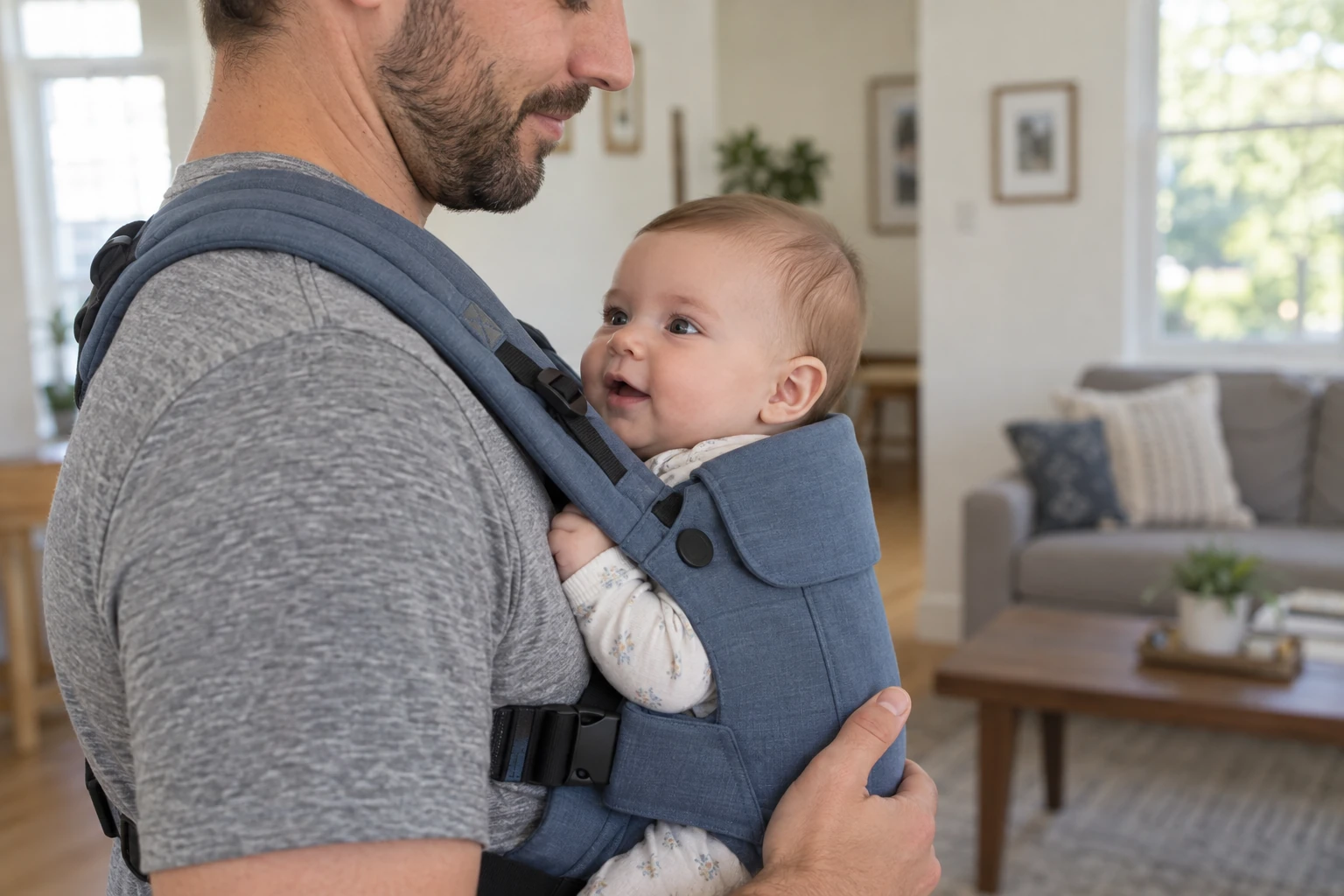
TICKS is the name used in the UK guidance below. The letters are a memory aid, not a product rating. Read each point as a separate observation of the baby and the carrier. For a shared family routine, one adult can read the words while the wearer describes what they can actually see. The purpose is a clear description, not a score or a photograph to imitate exactly.
- T — Tight: fit the carrier closely enough to support the baby, because loose fabric can let the body slide down into a slumped position. [Norfolk and Waveney Children and Young People’s Health Services / NHS]
- I — In view: you should be able to see the face by looking down, without opening fabric that has closed over the baby. [Norfolk and Waveney Children and Young People’s Health Services / NHS]
- C — Close: position the baby high enough that you can kiss the top of their head. [NHS]
- K — Keep the chin off the chest: always leave at least a finger-width gap below the chin rather than allowing the head to fold forward onto the body. [Norfolk and Waveney Children and Young People’s Health Services / NHS]
- S — Supported back: support the back in its natural position, with the baby’s chest and tummy against you in an upright carry. [Norfolk and Waveney Children and Young People’s Health Services / NHS]
For young babies or babies with poor neck control, use an inward-facing position with the head and back supported, and ask the baby’s clinician whether the carrier is suitable. [Health Service Executive (HSE)]
Do not bunch the baby’s legs up against the stomach, because this can restrict breathing. [Queensland Government / Office of Fair Trading]
Choose the product, then learn its exact fit
A product name, a carrying position and an individual fit are different pieces of information. In a question to the manufacturer, include all three. For example, “this model, front carry, this setting” gives more context than “a newborn carrier.” The record near the end leaves space for the model and the instructions you used, so another caregiver can find the same information later.
Choose a carrier that suits your baby’s age, size and development, and follow the manufacturer’s assembly and use instructions. [Australian Competition and Consumer Commission; official copy hosted by NSW Health]
Check the product’s weight limits and make sure you have readable instructions, including when the carrier is borrowed or bought second-hand. [U.S. Consumer Product Safety Commission] [Australian Competition and Consumer Commission; official copy hosted by NSW Health]
Ask for a demonstration and have someone help when you first learn to put the baby into the carrier and take them out. [Australian Competition and Consumer Commission; official copy hosted by NSW Health] [Queensland Government / Office of Fair Trading]
The carrier should support the baby’s back, and the leg openings should be small enough that the baby cannot slip through them. [American Academy of Pediatrics / HealthyChildren.org]
Check for recalls when selecting a carrier, as well as checking its condition and instructions. [Australian Competition and Consumer Commission; official copy hosted by NSW Health]
A practical sequence before and during a carry
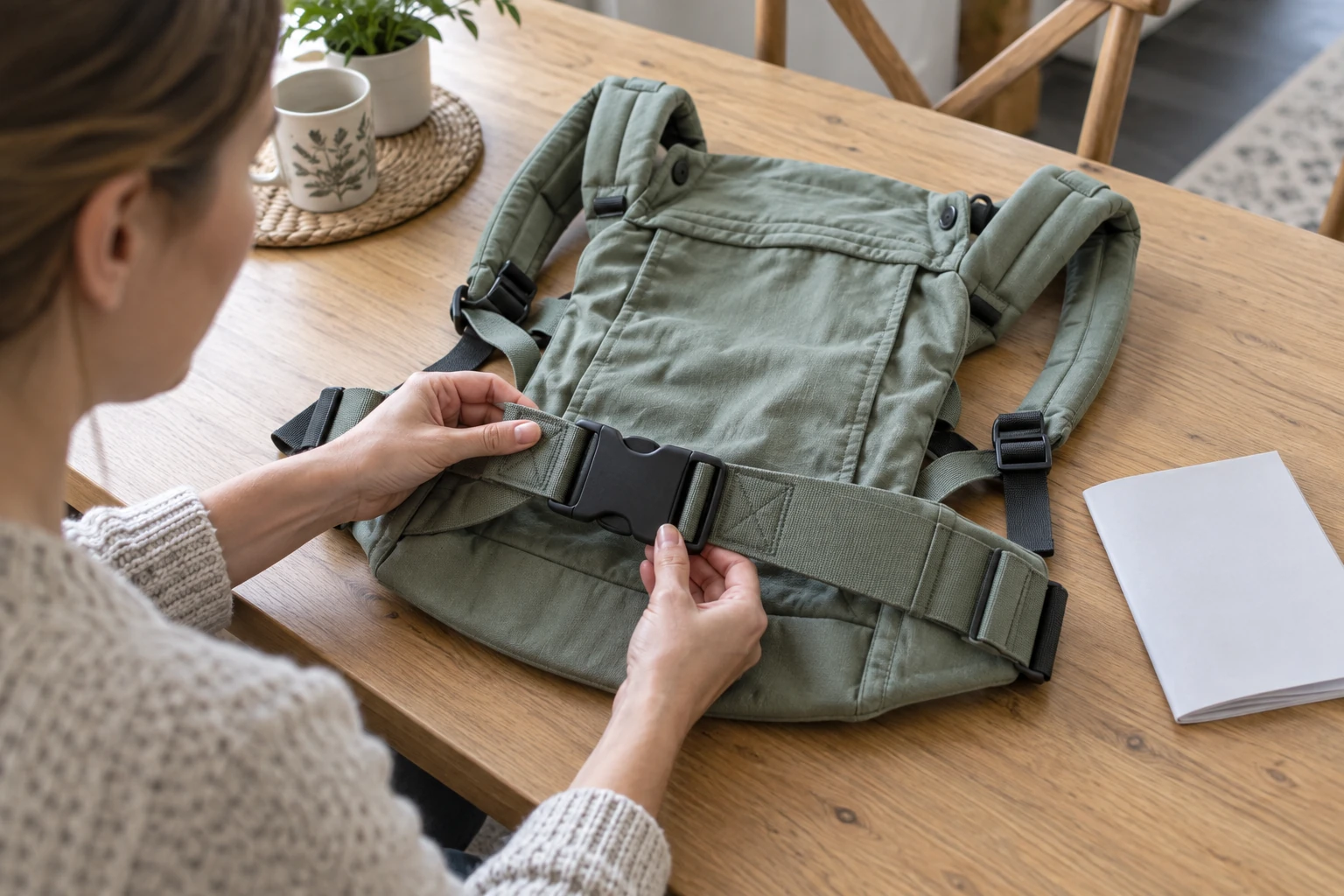
Keep the equipment check and the baby check separate. The first concerns fabric and fasteners; the second concerns the baby’s position and response. A buckle being closed answers an equipment question. It does not describe the baby’s chin or nose. The sequence below follows that distinction so there is a clear place for both kinds of observation.
- Before use, inspect seams, straps and fasteners for damage, and check that knots or ring fastenings are secure according to the product instructions. [Queensland Government / Office of Fair Trading]
- Do not use the carrier again while torn seams, frayed straps or loose or missing fasteners remain unresolved. [Australian Competition and Consumer Commission; official copy hosted by NSW Health] [Health Service Executive (HSE)]
- Use all the required restraining straps and make sure the baby is secured before you begin walking. [Australian Competition and Consumer Commission; official copy hosted by NSW Health] [American Academy of Pediatrics / HealthyChildren.org]
- Check the visible face, uncovered nose and mouth, chin clearance and supported back before continuing the carry. [NHS] [American Academy of Pediatrics / HealthyChildren.org]
- Keep checking position and breathing during the carry, rather than treating the initial fit check as the end of the task. [Queensland Government / Office of Fair Trading] [American Academy of Pediatrics / HealthyChildren.org]
If you need to reach down while wearing the carrier, bend your knees instead of folding at the waist. [American Academy of Pediatrics / HealthyChildren.org]
Do not wear the baby while running, cycling, preparing meals, or handling hot food and drinks. [Australian Competition and Consumer Commission; official copy hosted by NSW Health] [Queensland Government / Office of Fair Trading]
Age, health and everyday differences
There is no single family scenario behind the word babywearing. One caregiver may be learning a wrap with a newborn; another may be checking a carrier after their older baby has grown. A useful conversation starts with the particular baby and the particular product. The following distinctions explain why the same answer is not automatically suitable for everyone.
Babies younger than four months, babies born prematurely or at low birth weight, and babies with breathing problems need particular caution with slings and advice from their pediatrician. [U.S. Consumer Product Safety Commission] [Queensland Government / Office of Fair Trading] [Australian Competition and Consumer Commission; official copy hosted by NSW Health] [Health Service Executive (HSE)]
The AAP advises against placing premature infants or infants with respiratory problems in backpacks or other upright positioning devices because the position may make breathing harder. [American Academy of Pediatrics / HealthyChildren.org]
For a premature or medically vulnerable baby, ask the clinical team whether this specific carrier and position are appropriate before using them. [U.S. Consumer Product Safety Commission] [American Academy of Pediatrics / HealthyChildren.org]
A framed backpack carrier is not recommended for babies younger than four months; consult a health professional before using one at any age. This guidance is separate from a soft carrier’s own instructions. [Australian Competition and Consumer Commission; official copy hosted by NSW Health]
As babies become more active, they may push against the carrier or your body, so continue using the restraints and checking how they are seated. [American Academy of Pediatrics / HealthyChildren.org]
For a separate discussion of development, read our guide to tummy time and head control.
Keep coats and other clothing away from the baby’s face so their nose and mouth stay clear, and adjust clothing if the baby becomes too warm. [Health Service Executive (HSE)] [American Academy of Pediatrics / HealthyChildren.org]
Pause the carry for feeding
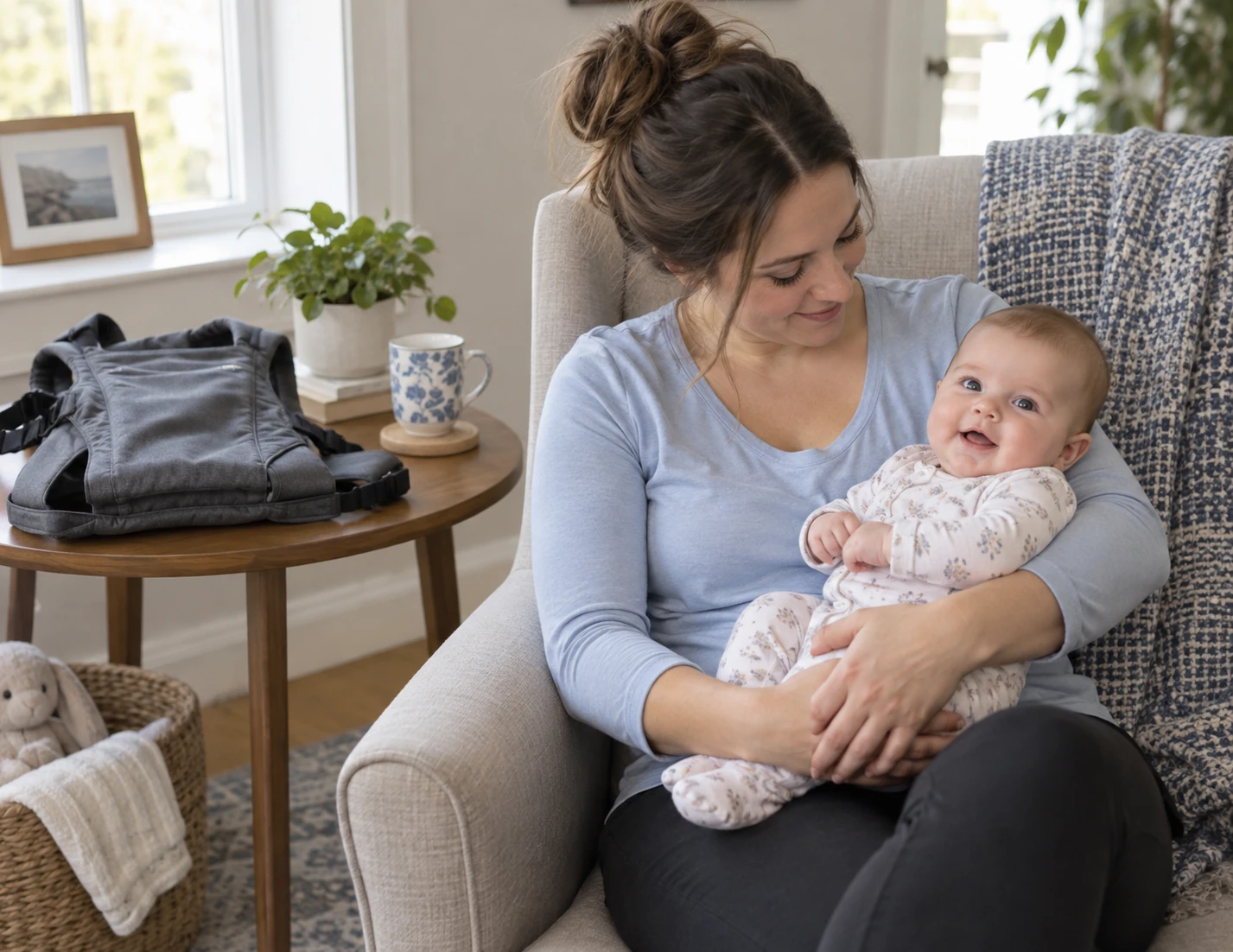
The NHS advises taking babies out of slings for both breastfeeding and bottle feeding; hands-free feeding while moving or doing other jobs is unsafe. [NHS] [Norfolk and Waveney Children and Young People’s Health Services / NHS] [NHS Best Start in Life]
For this guide, feeding and carrying are separate parts of the routine. “Take out, feed, then decide what comes next” is the sequence used in the examples. It also gives a straightforward instruction to a partner or babysitter without asking them to learn a special in-carrier feeding technique. Feeding support itself can be discussed separately with the baby’s usual healthcare professional.
The NHS and Ireland’s HSE advise taking the baby out of a sling or carrier for feeds; this guide follows that advice for both breastfeeding and bottle feeding. [NHS] [Health Service Executive (HSE)] [NHS Best Start in Life]
If you use the carrier again after a feed, restore the upright supported position with the face visible, the nose and mouth free, and the chin away from the chest. [NHS] [Queensland Government / Office of Fair Trading]
Sleep belongs in a separate sleep space

A carrier or sling is not a routine sleep space; when a baby falls asleep there, transfer them onto their back on a firm, flat, non-inclined sleep surface as soon as possible. [American Academy of Pediatrics / HealthyChildren.org] [American Academy of Pediatrics / HealthyChildren.org]
Use a crib, bassinet or other infant sleep product that meets current U.S. Consumer Product Safety Commission (CPSC) safety standards, with a fitted sheet and no pillows, loose blankets or soft toys. [American Academy of Pediatrics / HealthyChildren.org]
Our safe sleep space guide has a separate setup checklist for the place where you will put the baby down.
While arranging the transfer, keep checking breathing and chin position; monitoring does not turn a carrier into a safe sleep surface. [Health Service Executive (HSE)] [American Academy of Pediatrics / HealthyChildren.org] [American Academy of Pediatrics / HealthyChildren.org]
Reflux does not make an inclined sleep position the safer default; the AAP recommends flat, back sleeping even for babies with gastroesophageal reflux disease. [American Academy of Pediatrics / HealthyChildren.org]
Do not fall asleep on a sofa or armchair while holding the baby. [American Academy of Pediatrics / HealthyChildren.org]
If the next question is who can take over, our caregiver rest and support guide includes ideas for discussing that handover.
A sleep plan can be written in ordinary household language: which sleep space will be used, where it is, and which adult is taking over. Those are practical arrangements, not a new medical rule. Include them in the handover note if more than one person cares for the baby. The aim is to make the next action clear before everyone is tired and trying to negotiate it.
Stop and seek help when the concern is medical
Seek emergency help for difficulty breathing, very fast breathing, blue or grey lips or skin, or a baby who is difficult to wake or cannot be woken. [NHS]
Grunting, the chest or tummy pulling in with breaths, and nostrils flaring are signs of increased breathing effort that need emergency medical help. [NHS]
Do not wait for every warning sign to appear before seeking help; if you think something is seriously wrong, get immediate medical help. [NHS]
If the baby is unresponsive and not breathing normally, call your local emergency number, start infant CPR immediately, and follow the dispatcher’s instructions. [NHS]
If you are worried about symptoms or unsure what to do without an immediate emergency sign, contact an urgent medical advice service or the baby’s clinician. [NHS]
For language to describe what you have noticed, see our baby breathing observation guide; the urgent-care advice above still applies.
A fitting question can be written as “I cannot work out this strap.” A medical concern describes the baby: “breathing looked different” or “they were unusually hard to wake.” Keep those descriptions separate in a call. This article does not diagnose why a symptom happened, and a later adjustment of the carrier cannot establish the cause of an earlier episode.
Prepare the questions that belong in a fitting session
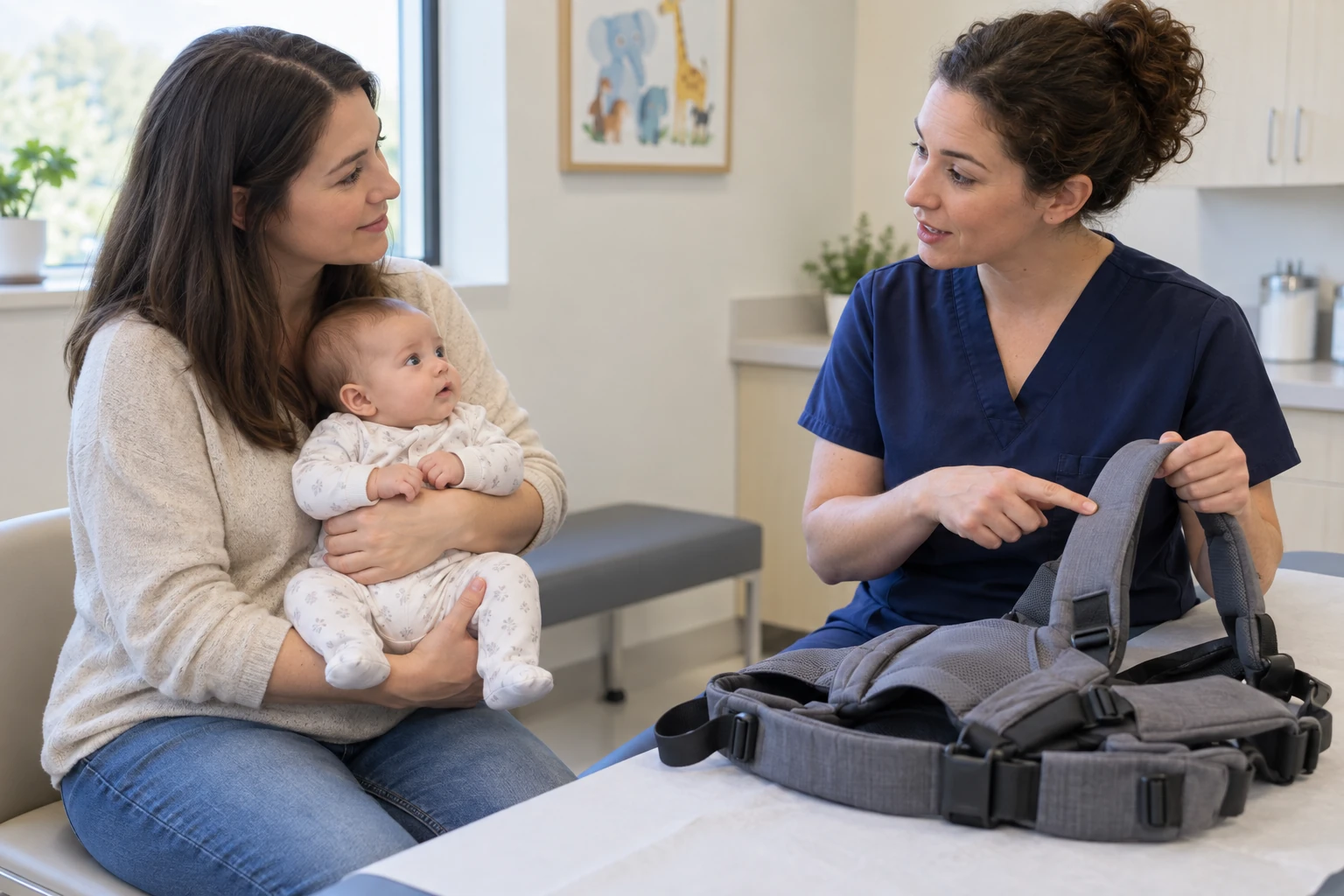
Bring the actual carrier manual into the conversation. There are practical questions that a general article cannot answer for a named model: which adjustment changes the seat, where the supporting panel should sit for this configuration, and how the fastening is released. Write the questions using the manufacturer’s own part names when available. That keeps a discussion about the waist strap from being confused with a discussion about a shoulder strap.
A second useful set of questions is about the handover: who knows how this model works, who has the manual, and what remains unclear? An adult who used a different carrier may have a different sequence in mind. Make the conversation specific to this product. This is a way to organise the instructions already supplied with the carrier, not permission to invent a fastening, knot or extra support that the manual does not describe.
For an appointment about the baby rather than the equipment, put the observation first. “The chin dropped when we walked” and “I could not see the mouth” describe different concerns. Add what you noticed before and after taking the baby out, without assigning a diagnosis yourself. The record below gives those observations their own space so the product description does not crowd out the reason you are asking for help.
A short record for caregivers and appointments
The following is an optional note template, not a diagnostic checklist. It is designed to keep observations separate from questions. There is no required target duration and no pass or fail score. Copy only the fields that are useful for your household, and leave unknown details blank rather than guessing.
- Date, caregiver and setting
- ____________________
- Baby’s age; relevant history already discussed with the clinician
- ____________________
- Carrier brand, model and manual or label
- ____________________
- Carrying position and settings used
- ____________________
- Face, nose, mouth, chin and back observations
- ____________________
- Changes in breathing, colour or responsiveness
- ____________________
- What happened before and after removal
- ____________________
- Feeding break or sleep transfer
- ____________________
- Advice sought and unresolved questions
- ____________________
An example entry might say: “Front carry; label and manual available; asked for help with the shoulder adjustment; feeding break outside the carrier; question for the next appointment.” This is a wording example, not a report about a real baby or a demonstration that a particular fit is safe. The useful part is the separation of what happened, what you did and what you still want to ask.
Do not delay urgent care in order to complete the record or take a photograph. [NHS]
Frequently asked questions
Does seeing the nose mean the position is safe?
A visible nose alone is not enough: the mouth must also be unobstructed, and chin-to-chest curling can restrict breathing even when the face is uncovered. [U.S. Consumer Product Safety Commission] [American Academy of Pediatrics / HealthyChildren.org]
Can I keep the baby in the sling during a feed?
Take the baby out for feeding, following NHS advice; this applies to breastfeeds and bottle feeds. [NHS] [NHS Best Start in Life]
Can a carrier replace a crib if I keep watching?
No; when a baby falls asleep in a carrier or sling, move them to a firm, non-inclined sleep surface as soon as possible. [American Academy of Pediatrics / HealthyChildren.org]
Is a premature baby ready when the weight label fits?
A weight label does not settle the medical question; discuss the particular carrier and position with the baby’s clinical team before use. [U.S. Consumer Product Safety Commission] [American Academy of Pediatrics / HealthyChildren.org]
Sources
- Baby and toddler safety — NHS. Accessed: 2026-09-23.
- Safety Standard for Sling Carriers: Proposed Rule briefing package (2014) — U.S. Consumer Product Safety Commission. Accessed: 2026-09-23.
- Baby Carriers: Backpacks, Front Packs & Slings — American Academy of Pediatrics / HealthyChildren.org. Accessed: 2026-09-23.
- How to Keep Your Sleeping Baby Safe: AAP Policy Explained — American Academy of Pediatrics / HealthyChildren.org. Accessed: 2026-09-23.
- When to get urgent medical help for babies and children under 5 — NHS. Accessed: 2026-09-23.
- What Do I Really Need for My Baby — Norfolk and Waveney Children and Young People’s Health Services / NHS. Accessed: 2026-09-23.
- Baby slings — Queensland Government / Office of Fair Trading. Accessed: 2026-09-23.
- Keeping baby safe — Baby carriers and Baby slings (2013) — Australian Competition and Consumer Commission; official copy hosted by NSW Health. Accessed: 2026-09-23.
- Safe Sleep: 9 Ways to Reduce a Baby’s Risk of SIDS & Suffocation — American Academy of Pediatrics / HealthyChildren.org. Accessed: 2026-09-23.
- How to resuscitate a child — NHS. Accessed: 2026-09-23.
- What to buy for your newborn baby — NHS Best Start in Life. Accessed: 2026-09-23.
- Baby carriers and sling safety — Health Service Executive (HSE). Accessed: 2026-09-23.
This educational guide supports conversations with your baby’s healthcare team and the carrier manufacturer. It does not replace an individual medical assessment, emergency help or the instructions for your product. Images illustrate the topic; they do not certify a particular carrier or fit.