Hip Dysplasia: Baby Signs and Early Checks

If you notice unequal leg lengths, uneven thigh or buttock folds, or less movement on one side, contact your child’s clinician for a hip assessment.
For caregivers of newborns, infants and toddlers who have begun walking.
SUMMARY
- Folds alone cannot diagnose hip dysplasia.
- Contact your child’s clinician.
- Keep routine hip checks.
- If swaddling, leave legs free.
Why appearance is only part of the check
Developmental dysplasia of the hip (DDH) means the hip joint has not formed normally, so the ball of the thighbone may be unstable in its socket or dislocated. DDH can affect one or both hips and can develop after birth.
DDH is usually painless in babies. Some babies with DDH have no outward signs. When both hips are affected, the legs may look alike, so symmetry does not rule out DDH.
What you notice during everyday care
| Observation | What it can mean | Next step |
|---|---|---|
| Uneven thigh or buttock folds | Uneven folds can occur even when the rest of the hip examination is normal. | Contact your child’s clinician. |
| Length or movement difference | If one leg seems shorter or moves less during play or diaper changes, arrange a hip assessment. | Contact your child’s clinician. |
| Crawling or walking change | Dragging one leg while crawling or limping when walking also needs assessment. | Contact your child’s clinician. |

Folds alone cannot diagnose hip dysplasia.
Describe which side caught your attention and what you saw during ordinary play or care.
A trained clinician checks how the hips move, using a gentle examination.
What to discuss at the appointment
Breech position during pregnancy and a family history of DDH increase the likelihood of DDH. Tell the clinician about breech position and affected family members, even if your baby’s hips previously seemed normal.

Early checks and scans
A normal early examination does not replace later hip checks.
In the US, hip checks are recommended after birth and at well-child visits until the child is walking normally. The UK newborn screening schedule includes a hip examination within 72 hours of birth and again at 6–8 weeks.
Ask your own care team which local check and follow-up schedule applies to your child.
A clinician may arrange hip ultrasound for a young baby or an X-ray for an older infant or child, depending on age and findings. Suspected DDH may lead to referral to a specialist in children’s bone and joint problems.
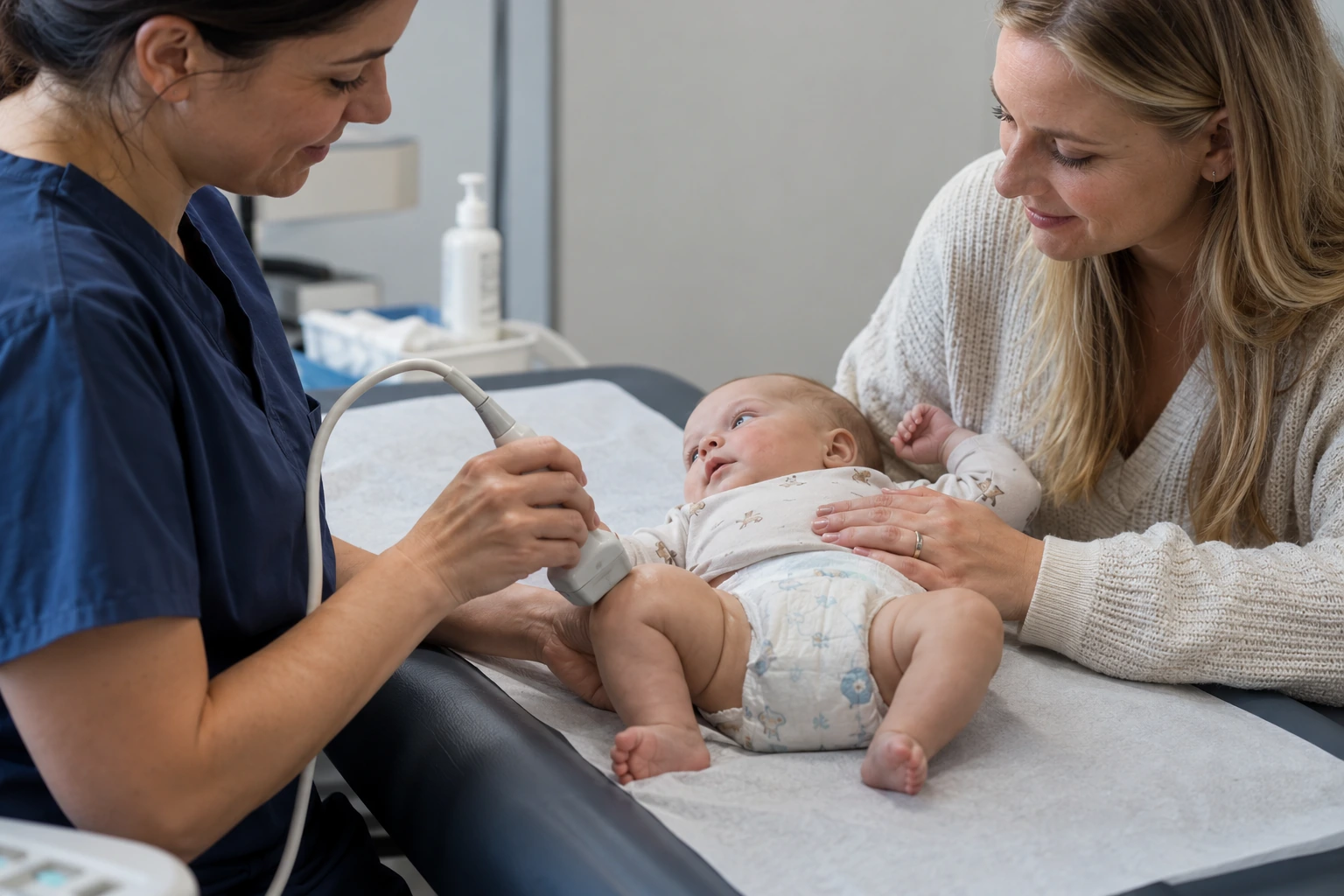
Before leaving, ask who will arrange any referral or scan and how you will receive the appointment.
Keep the legs free during wrapping
If swaddling, leave legs free. Do not bind the legs together with the hips and knees forced straight when swaddling. Leave room for the hips and knees to bend and the legs to move outward naturally.

If DDH is found
A Pavlik harness is a soft brace that holds the hips in position while allowing leg movement.
Finding DDH early can allow treatment with a harness or brace; later treatment may be more complex. Treatment depends on the child’s age and hip findings and may involve a brace, a cast or surgery.
If a harness is prescribed, follow the team’s fitting and care instructions and attend the scheduled checks.
When a walking child needs urgent help
An unexplained limp should be checked even if your toddler does not complain of pain.

For a walking child who cannot bear weight or develops sudden hip, knee or thigh pain, seek emergency care. A limp with a high temperature and a child who is generally unwell also needs emergency care.
Questions about clicks and follow-up
Does a clicking sound always mean DDH?
A soft-tissue click is different from the clunk a clinician feels during hip instability testing; a click alone is not proof of DDH.
Does every mild early finding need immediate treatment?
Some mild early hip findings resolve, so a specialist may recommend planned follow-up rather than immediate treatment.
Sources
- American Academy of Orthopaedic Surgeons — OrthoInfo — Developmental Dysplasia of the Hip (DDH)
- American Academy of Pediatrics — HealthyChildren.org — Hip Dysplasia
- American Academy of Family Physicians — American Family Physician — Common Questions About Developmental Dysplasia of the Hip
- NHS — Newborn physical examination
- NHS — Limping in children