Bottle Nipple Flow and Baby Feeding Cues

This guide is for parents and other caregivers choosing a bottle nipple for a baby under one year. It separates the label on the package from what happens during a feed: the baby’s interest, sucking, swallowing, pauses and response to the bottle. You will find an explanation of flow, examples of feeding cues, practical handling steps, situations that need medical help, and a short record to bring to a conversation with a clinician. Nipple and teat mean the same bottle part here.
SUMMARY
Watch your baby, not the age label. [Nationwide Children’s Hospital]
If your baby is healthy, feeding comfortably and growing well, keep the current flow. [Nationwide Children’s Hospital]
Gulping or coughing? Pause the feed. [Cambridge University Hospitals NHS Foundation Trust] [Department of Health and Social Care / UNICEF UK Baby Friendly Initiative]
Ask your clinician about repeated feeding trouble. [American Speech-Language-Hearing Association] [American Speech-Language-Hearing Association]
What flow labels can and cannot tell you
A number on a package is easy to compare. A feed takes more description. In this guide, the label identifies a product, while the feeding observations describe the baby. Those are two separate columns in the record below. There is no brand league table or shopping checklist of must-have shapes. The useful question is what the product description means in the context of the feed in front of you.
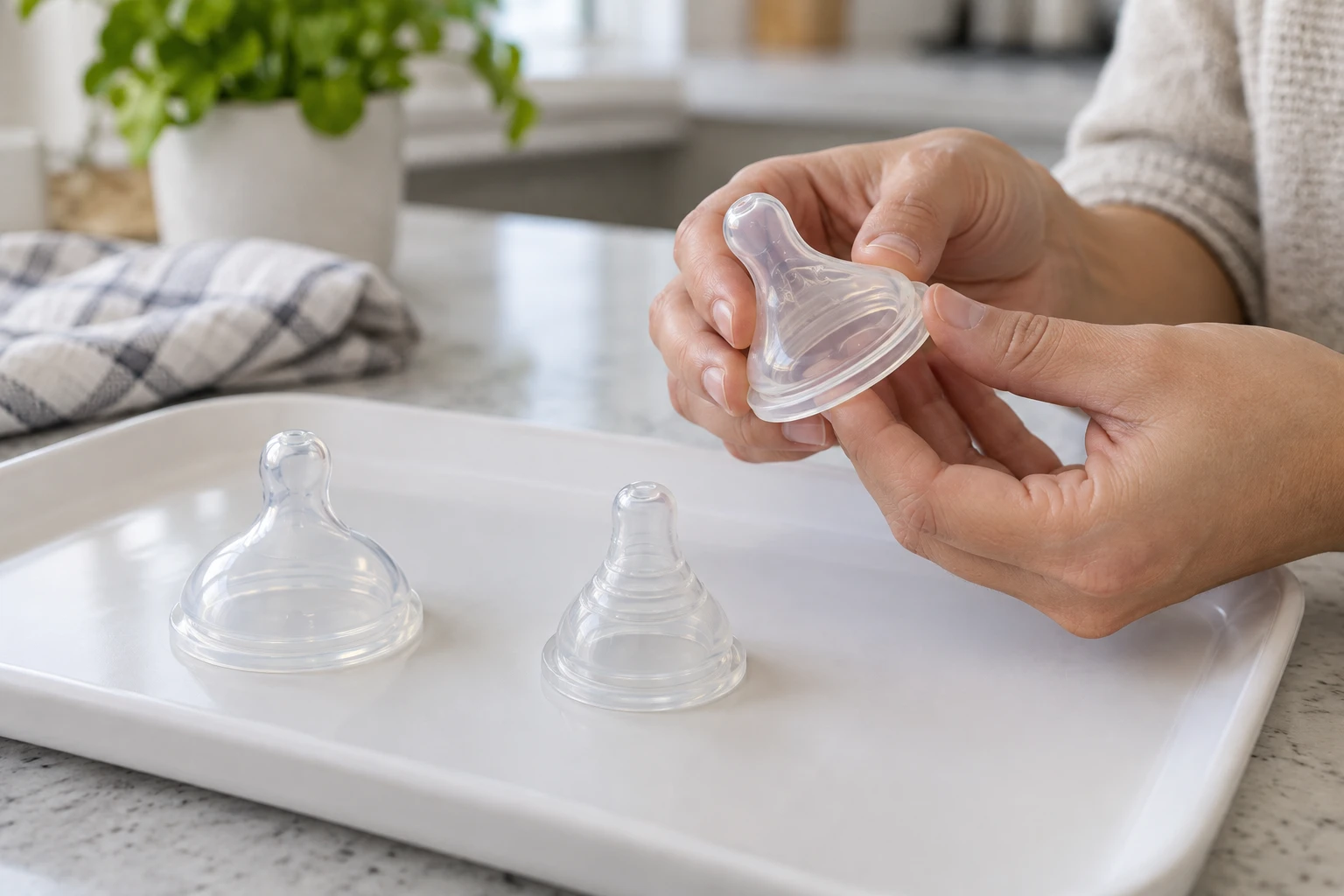
Bottle nipple flow means how quickly milk moves through the teat into the mouth; packaging may describe it with a number, an age range, or words such as slow and fast. [St George’s University Hospitals NHS Foundation Trust]
During feeding, babies coordinate sucking, swallowing and breathing, with pauses that give them a chance to take additional breaths. [Cambridge University Hospitals NHS Foundation Trust]
Too little flow can make getting milk harder work, while too much can be difficult to handle; choosing flow is about a workable pace for this baby. [Nationwide Children’s Hospital]
Nipples with similar labels can perform differently across brands and even within one brand; sucking pressure, nipple flexibility, bottle pressure and milk thickness can also affect flow. [American Speech-Language-Hearing Association]
A flow table compares particular products, so it cannot by itself tell you which nipple your baby will manage comfortably. [St George’s University Hospitals NHS Foundation Trust]
The NHS does not identify one bottle or teat type as better than every other type. [NHS]
A teat marketed as breast-shaped or especially easy to latch onto has not, by that wording alone, demonstrated that it will solve a feeding difficulty. [St George’s University Hospitals NHS Foundation Trust]
Many babies born around their due date can start with a newborn or slow-flow nipple, whether the bottle contains expressed breast milk or infant formula. [Nationwide Children’s Hospital]
Hunger, fullness and ordinary pauses
For babies without a different prescribed plan, responsive feeding means offering milk when hunger cues appear and respecting the baby’s signals during the feed. [NHS Best Start in Life]
From birth to 5 months, hunger cues may include sucking hands or fingers, turning to look for the bottle teat, and opening and closing the mouth. [NHS Best Start in Life]
Crying can follow earlier hunger cues; slowing or stopping sucking and turning the head away can signal fullness in these younger babies. [NHS Best Start in Life] [American Academy of Pediatrics / HealthyChildren.org]
For babies aged 6–11 months who are already eating solid foods, firmly closing the mouth or turning the head away can mean they have had enough; respect these signals during meals as well as milk feeds. [NHS]
Rooting is the reflex in which a baby turns the head and makes sucking movements toward a touch near the cheek or mouth; it is one cue to notice when offering the teat. [Health Service Executive]
When a baby is already upset, a cuddle or skin-to-skin contact may help before feeding; crying also has causes other than hunger. [NHS Best Start in Life]
Paced feeding supports the baby’s control by allowing small runs of drinking followed by rest, rather than expecting continuous sucking from the first mouthful to an empty bottle. [NHS Best Start in Life]

When the flow looks too fast or too slow
The following signs describe what you might see, not a home diagnosis. The distinction matters when someone asks, “Was the bottle too fast?” An observation such as milk at the corner of the mouth is different from a conclusion about why it happened. Keep the descriptive wording when explaining the feed to another caregiver or clinician.
Gulping, coughing, hard swallowing, extra drooling or refusing the bottle may indicate excessive flow; a slower-flow nipple may help. [Nationwide Children’s Hospital]
Longer feeds, rapid sucking with few swallows, a collapsing nipple or feeding frustration may suggest that flow is too slow. [Nationwide Children’s Hospital]
These observations do not diagnose a nipple problem, because feeding or swallowing difficulties can also involve coughing, refusal, long feeds, breathing trouble or poor growth. [American Speech-Language-Hearing Association]
Feeding difficulties can concern sucking or taking milk, while a swallowing difficulty concerns moving liquid safely through the mouth and throat toward the stomach. [American Speech-Language-Hearing Association]
Some feeding or swallowing problems occur with another medical condition, and some have no known cause, which is another reason not to assume the bottle explains everything. [American Speech-Language-Hearing Association]
A slower nipple can support coordination of sucking, swallowing and breathing, but clinical flow selection still depends on how the individual infant feeds. [American Speech-Language-Hearing Association]
A break is part of feeding
Spreading fingers or toes, spilling milk, stopping sucking, turning away or pushing the bottle away can mean a break is needed; gently lower the bottle or remove the teat to stop the milk flow. [Department of Health and Social Care / UNICEF UK Baby Friendly Initiative]
Let pauses be part of the feed, then follow renewed interest or fullness cues instead of immediately putting the nipple back into the mouth. [Health Service Executive]
A pause may also be a time for a burp; the bottle-feeding leaflet describes holding the baby upright and gently rubbing or patting the back when the baby has finished. [Department of Health and Social Care / UNICEF UK Baby Friendly Initiative]
Trying to make a baby finish a bottle despite stopping cues can cause distress and overfeeding. [NHS Best Start in Life]
A bigger feed does not guarantee a longer interval before the next one, so finishing extra milk is not a reliable way to secure a longer stretch of sleep. [NHS Best Start in Life]

Different milk and different medical needs
The same words can appear in a general parenting leaflet and in instructions for a neonatal ward, but their audiences differ. This section keeps those settings separate.
A neonatal feeding plan may mention particular equipment, positions or scheduled feeds; the everyday examples elsewhere in this article are not a replacement for that written plan. [Cambridge University Hospitals NHS Foundation Trust]
For expressed breast milk, HSE recommends a slow-flow teat to support pacing, and notes that the amount taken may differ from one feed to the next. [Health Service Executive]
Expressed milk in a bottle still calls for attention to the baby’s cues, without forcing a fixed bottle amount to be finished. [Health Service Executive]
Premature babies and babies needing neonatal care may need a slower flow and an individual feeding plan, including a position taught by their care team. [Cambridge University Hospitals NHS Foundation Trust]
CUH describes elevated side-lying for some babies born early or needing special care; that neonatal instruction is not a universal position for every baby at home. [Cambridge University Hospitals NHS Foundation Trust]
When a baby was premature or unwell at birth, discuss the teat and feeding position with the neonatal nurse or feeding therapist, because extra support may be needed. [St George’s University Hospitals NHS Foundation Trust]
If a baby in neonatal care struggles with bottles, CUH advises involving the infant-feeding team or a speech and language therapist rather than repeatedly searching for a different teat shape. [Cambridge University Hospitals NHS Foundation Trust]
For babies with craniofacial conditions, a specialist may watch an actual feed and develop a plan addressing the baby’s particular feeding and growth needs. [Seattle Children’s]
Offer the bottle and follow the response
For routine bottle feeds, hold your baby close and semi-upright with the head supported, and keep the bottle almost horizontal with a slight tip. [NHS]
Touch the teat gently to the upper lip and allow the baby to open the mouth and draw it in. [NHS Best Start in Life]
Keep the baby in your arms and the bottle in your hand, and set aside other tasks so you can watch the baby’s response. [Health Service Executive]
A small tilt can keep milk in the teat while the bottle stays broadly horizontal, and lowering it during a pause reduces the incoming milk while the baby rests. [Health Service Executive]
For a breastfed baby’s first bottles, choose a relaxed time before hunger becomes intense; let the baby take small amounts with pauses, and follow their cues rather than making them finish. [NHS] [NHS Best Start in Life]
Learning to drink from a bottle can take time, and a breastfed baby may accept a bottle more readily from another caregiver. [NHS]
Check the equipment before changing levels
There are two different questions here: whether the current nipple is intact and assembled correctly, and whether its flow suits the baby. A description of a leak belongs in the first question. The baby’s response during a feed belongs in the second. The notes template has room for both so the account does not reduce everything to the nipple’s printed number.
If the teat flattens, the NHS advises gently releasing suction at the corner of the mouth; if it is blocked, replace it with another sterile teat. [NHS]
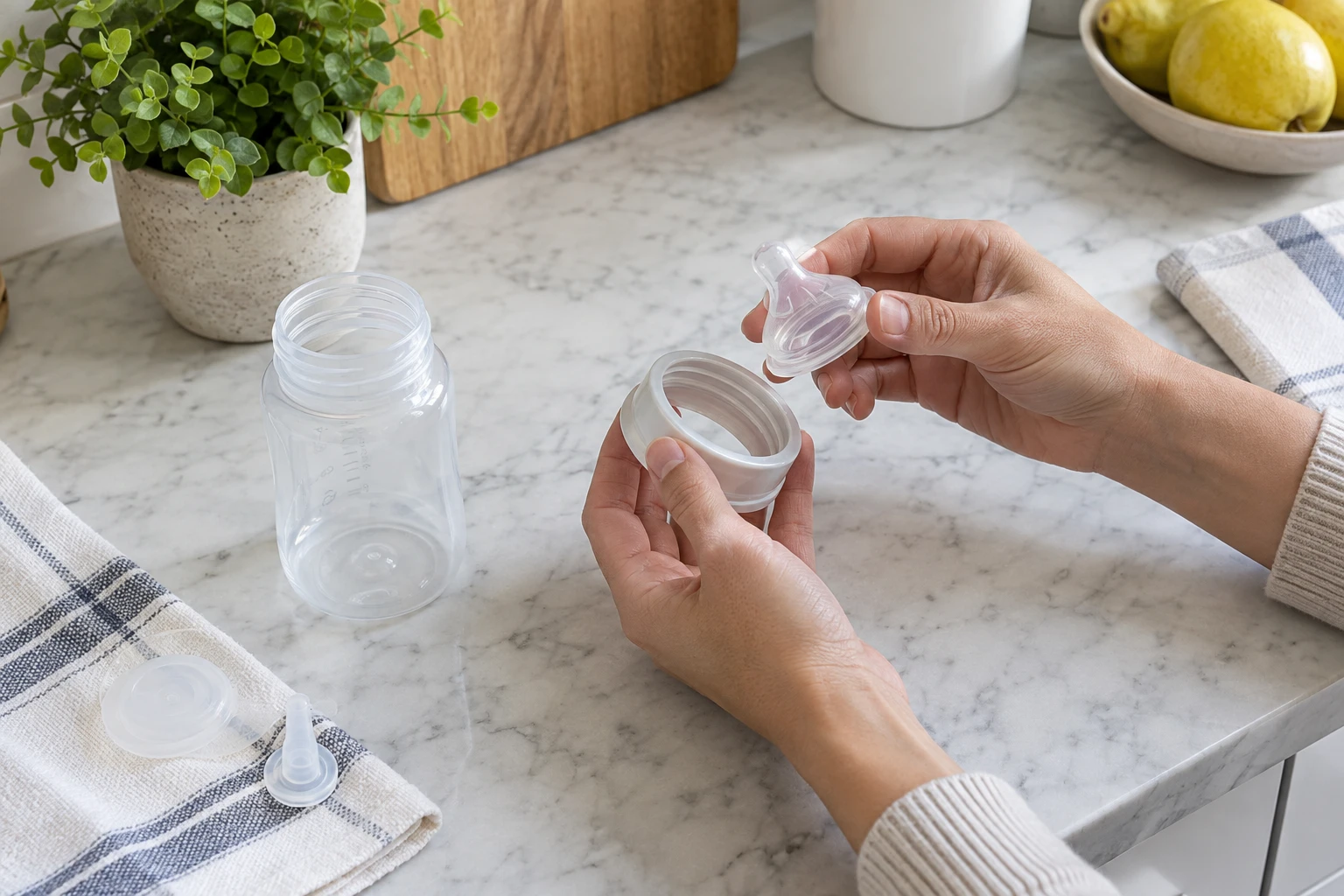
Replace nipples that are cracked, torn, thinned, sticky, swollen or otherwise worn. [Nationwide Children’s Hospital]
For leaks, check the ring’s fit and that any required anti-colic insert is correctly in place. [Nationwide Children’s Hospital]
The NHS advises cleaning bottles, nipples and all other feeding equipment in hot, soapy water as soon as possible after feeds, then rinsing before sterilising; this applies to expressed milk as well as formula. [NHS]
Check the bottle and teat for damage before cleaning and preparing them; choosing a suitable flow does not replace checking that the equipment is intact. [Department of Health and Social Care / UNICEF UK Baby Friendly Initiative]
Changes to avoid
Do not add cereal or other solid food to a bottle on your own to change feeding or sleep; cereal does not help babies sleep through the night. Before a baby is developmentally ready, cereal can cause gagging or inhalation of the mixture into the lungs. Any medically recommended thickening needs the baby’s own treatment plan. [NHS] [American Academy of Pediatrics / HealthyChildren.org] [American Academy of Pediatrics / HealthyChildren.org] [American Speech-Language-Hearing Association]
If thickening is being considered for a diagnosed swallowing problem, the care team should decide it after assessment rather than using a home recipe as a flow adjustment. [American Speech-Language-Hearing Association]
When changes such as thickening are considered, clinicians weigh the baby’s health, other conditions, potential risks and family preferences as part of an individual treatment decision. [American Speech-Language-Hearing Association]
Never prop a bottle or leave a baby feeding alone, including in bed, because milk can cause choking. [NHS]
Do not twist or jiggle the teat to push a baby into continuing to suck. [Cambridge University Hospitals NHS Foundation Trust]
Separate familiar spit-up from new concerns
A small amount of milk coming back up can be common in a happy, healthy baby who is gaining weight; discomfort and growth problems change that picture. [NHS]
Reflux can also involve coughing or unsettled feeds, so changing the nipple does not establish the cause of those symptoms. [NHS]
If reflux symptoms persist despite basic support, or your baby is losing weight or not gaining as expected, arrange a medical review instead of relying on nipple changes alone. [NHS]
When to get help
Repeated coughing, gagging, refusal, very long feeds, a wet or gurgly voice, or poor weight gain warrant professional advice; a baby need not show every sign. [American Speech-Language-Hearing Association]
Seek urgent medical advice for fewer wet diapers than usual, unusual drowsiness, few tears or a sunken soft spot, because these can be signs of dehydration. [NHS]
Dehydration means losing more fluid than the body takes in, and babies are particularly vulnerable; a change in wet diapers belongs alongside feeding concerns in a call for medical advice. [NHS]
Get emergency medical help now for breathing difficulty, blue or grey lips or skin, a baby who is difficult to wake, or no urine for 12 hours; use your local emergency service. [NHS]
Serious illness does not require every warning sign, and concern about a seriously unwell baby is enough reason to get immediate medical help. [NHS]
Feed refusal, green or yellow vomit, blood in vomit, forceful projectile vomiting, or inability to keep fluids down needs urgent medical assessment. [NHS]
When urgent warning signs are present, do not delay medical help to compare another nipple or complete a feeding log. [NHS] [NHS]
What a feeding review may involve
A feeding assessment considers medical history and the feeding process, including coordination, breathing, fatigue and intake, rather than only how much milk remains in the bottle. [American Speech-Language-Hearing Association]
In a specialist craniofacial service, some children need a swallow study to examine swallowing and possible milk entry into the airway; the team decides who needs that test. [Seattle Children’s]
A specialist visit may include teaching a different feeding technique or selecting special equipment, with follow-up based on the baby’s needs instead of a generic product ladder. [Seattle Children’s]

A short record for the next conversation
For a discussion of feeding, note the baby’s signals before, during and after the bottle, alongside what the caregiver did in response. [Health Service Executive]
The template below is an editorial note-taking aid, not a diagnostic score or a prescription for a certain number of feeds. Blank spaces mean that something was not recorded, rather than that a symptom was absent. You can copy the labels into a notebook or a message to your care team. The final line keeps the next question visible instead of turning the page into a list of products to buy.
| Record item | Your notes |
|---|---|
| Date, time and caregiver | ________ |
| Bottle brand, exact nipple name and printed level | ________ |
| Milk offered and any prescribed feeding instructions | ________ |
| Before feeding: awake, interested, upset, or other description | ________ |
| During feeding: sucking, swallows, pauses and sounds | ________ |
| Any coughing, dribbling, refusal or equipment leak | ________ |
| What the caregiver did and what happened afterward | ________ |
| Approximate duration, amount taken and recent wet diapers | ________ |
| My question and the clinician’s advice | ________ |
For example, an entry might read: “Tuesday, evening feed, usual bottle and nipple; hands near mouth before the feed; milk visible at one corner of the mouth; I paused; baby looked toward me afterward.” This is an invented example of wording, not a description of a normal feed or a recommendation to repeat that sequence. It reports events without adding “the flow was definitely too fast.” A separate question could be: “Can you watch us feed and review this nipple with us?”
Frequently asked questions
Must I move up at the next age label?
A baby may use the same nipple level throughout bottle feeding, so reaching the next printed age range does not require an automatic change. [Nationwide Children’s Hospital]
Does slow mean the same thing for every baby?
The word slow on a package is a product description, not a guarantee that the flow will suit every baby. [St George’s University Hospitals NHS Foundation Trust]
Does finishing the bottle prove intake is right?
If the amount your baby takes worries you, speak with the baby’s doctor rather than using bottle completion as the only measure. [American Academy of Pediatrics / HealthyChildren.org] [NHS]
What should I do about a blocked nipple?
If the teat flattens, the NHS advises gently releasing suction at the corner of the mouth; if it is blocked, replace it with another sterile teat. [NHS]
Related reading
The equipment discussion continues in our guide to bottle cleaning, sanitizing and drying. For the milk inside the bottle, see expressed milk storage and thawing. The separate guide to cup practice and moving on from bottles covers a later transition, while wet diapers and hydration focuses on the observations used in a hydration record. These articles each have their own scope and sources; the present guide stays with nipple flow and the baby’s signals during bottle feeds.
This article provides general parent education and does not diagnose feeding or swallowing problems or replace your baby’s individual medical advice. OhMyBaby Editorial Team prepared it from the sources below; no individual clinician review is claimed. Read the full guide at OhMyBaby.
Sources
Official sources accessed September 22, 2026.
- Choosing a Bottle Flow Rate — Nationwide Children’s Hospital
- Bottle feeding advice — NHS
- Supporting safe, effective and enjoyable bottle feeding — Cambridge University Hospitals NHS Foundation Trust
- Your baby's first solid foods — NHS
- How to combine breast and bottle feeding — NHS
- Feeding on demand — NHS Best Start in Life
- Pediatric Feeding and Swallowing — American Speech-Language-Hearing Association
- Early Identification of Speech, Language, Swallowing, and Hearing Disorders — American Speech-Language-Hearing Association
- Dehydration — NHS
- When to get urgent medical help for babies and children under 5 — NHS
- Reflux in babies — NHS
- Your Choice of Feeding Method — St George’s University Hospitals NHS Foundation Trust
- Using a bottle to give expressed milk — Health Service Executive
- How to give a baby a bottle — Health Service Executive
- Guide to bottle feeding — Department of Health and Social Care / UNICEF UK Baby Friendly Initiative
- Craniofacial Feeding Management — Seattle Children’s
- Infant Food and Feeding — American Academy of Pediatrics / HealthyChildren.org
- Cereal in a Bottle: Solid Food Shortcuts to Avoid — American Academy of Pediatrics / HealthyChildren.org
- Sterilising baby bottles — NHS