Baby Cup Training: Sips to Bottle Weaning
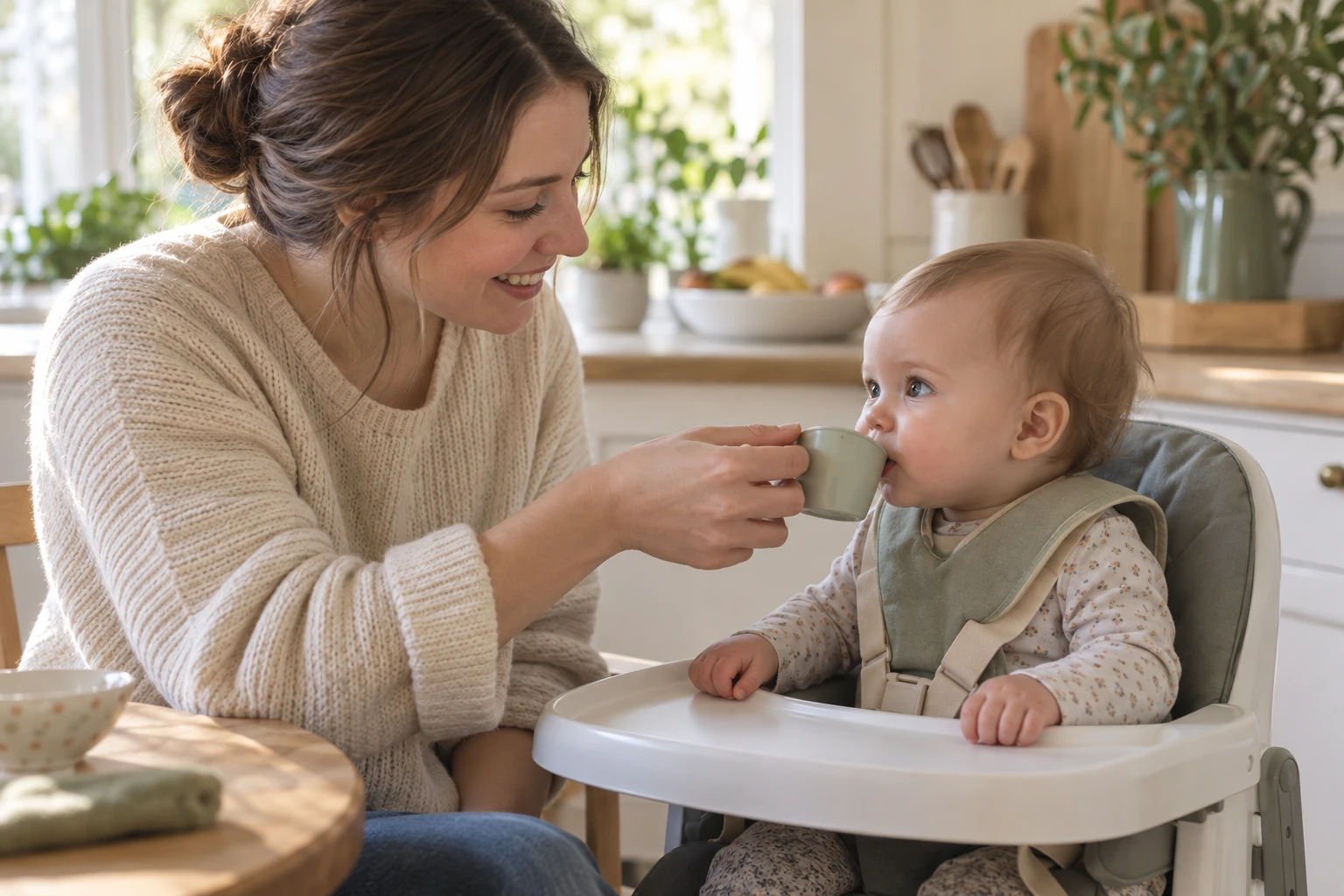
A first cup can raise surprisingly practical questions: straw or open rim, water or milk, practice or a replacement feed? This guide follows those decisions in order, from the first supported try to planning a gradual bottle transition. Keep the guidance for your baby’s current age separate from the advice about life after the first birthday.
SUMMARY
Start cup practice around six months, when solids begin. S01 · American Academy of Pediatrics S06 · NHS
Breast milk or formula stays the main drink throughout the first year. S06 · NHS
Never pour drinks into your baby’s mouth. S08 · The Dudley Group NHS Foundation Trust
A first cup and a last bottle are different steps
The phrase bottle weaning bundles several decisions together: the container your baby uses, what goes inside it, and the comfort attached to feeding. This guide separates those decisions. It is written for adults caring for babies under one year, with a look ahead to the bottle transition after the first birthday. The aim is a workable mealtime routine, not a dramatic goodbye to every bottle on the day a cup arrives. A cup on the table does not have to become a promise about tomorrow’s feeding schedule.
The American Academy of Pediatrics recommends gradually completing the bottle-to-cup transition between 12 and 18 months. S01 · American Academy of Pediatrics
UK NHS guidance discourages bottle feeding from 12 months. S02 · NHS
Cup practice does not require stopping breastfeeding; breastfeeding can continue for as long as parent and child want. S15 · American Academy of Pediatrics S06 · NHS
Here, “bottle weaning” means moving away from the bottle as a container. It is not a synonym for ending breastfeeding. The different US and UK wording is kept visible so a family does not mistake one country’s advice for a universal birthday deadline.
When to introduce an open cup or straw
An age on a cup package cannot answer every question about your child. It helps to ask what the age actually describes: a first supported try, learning to manage a rim, or drinking while an adult holds the cup. Those are different activities. The official pages below also phrase the starting points differently. Keeping the source beside the age is more useful than combining all of them into a single rigid chart.
The NHS suggests an open cup or a free-flow cup without a valve from around 6 months. S02 · NHS
The American Academy of Pediatrics includes open, sippy and straw cups as options for offering a little water from around 6 months. S07 · American Academy of Pediatrics
Children may reach feeding milestones earlier or later than others within the same age range. S04 · American Speech-Language-Hearing Association
Readiness and individual feeding plans
For a family already discussing the start of solids, the cup can be part of that conversation. A useful appointment question is: “What position and cup would you suggest for our baby, given how feeding is going now?” Describe what you actually see rather than asking whether your baby has passed a cup test. The following readiness signs concern starting solids; they are not a home diagnosis of swallowing ability or a score for choosing between cup brands.
For starting solids around 6 months, the NHS looks for sitting with a steady head, coordinating eyes, hands and mouth, and swallowing food rather than pushing it out, together. S06 · NHS
For prematurity, a chronic illness, physical differences or developmental delay, discuss a suitable feeding and cup-transition plan with your baby’s pediatrician or other clinician. S01 · American Academy of Pediatrics S06 · NHS
Cup feeding a newborn who cannot breastfeed directly is a different context from routine cup practice with solids. S08 · The Dudley Group NHS Foundation Trust
Choose a cup you can understand and clean
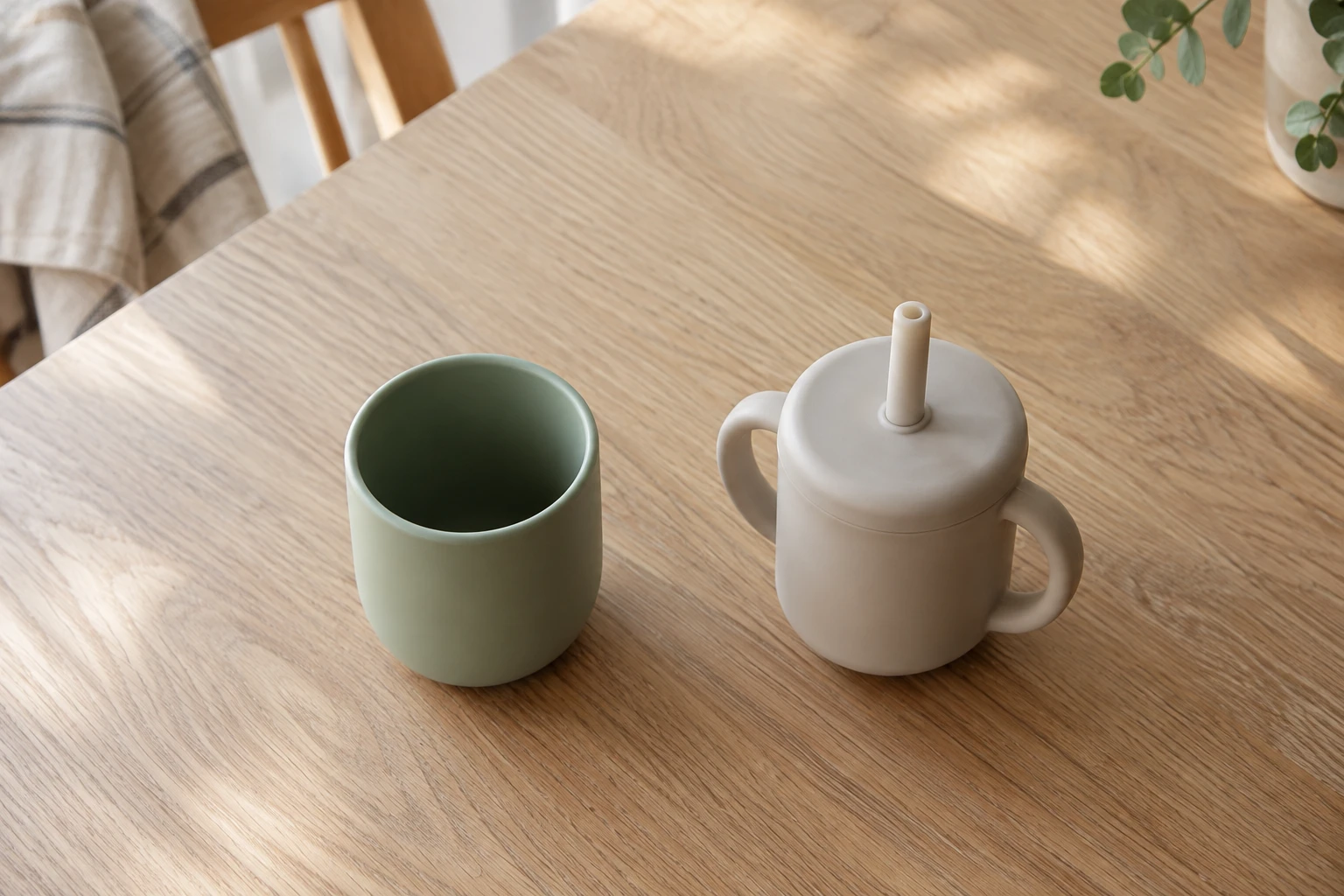
For this guide, an open cup means a cup with an uncovered rim. S02 · NHS A straw cup has a drinking straw; a spouted cup has a projecting drinking opening. These labels describe the object, not a ranking of babies. Before buying, the useful questions are practical: can you see how the drink reaches the mouth, can you identify every removable part, and do you understand the cleaning directions? Keep the product instructions with the cup so another caregiver can assemble the same pieces correctly.
A spouted training cup is optional, and a non-spill valve requires sucking rather than free-flow sipping. S01 · American Academy of Pediatrics S05 · Children and Family Health Devon, NHS
A small amount of liquid and an easy-to-hold cup can make early practice more manageable. S05 · Children and Family Health Devon, NHS
Set up a calm, supported first try
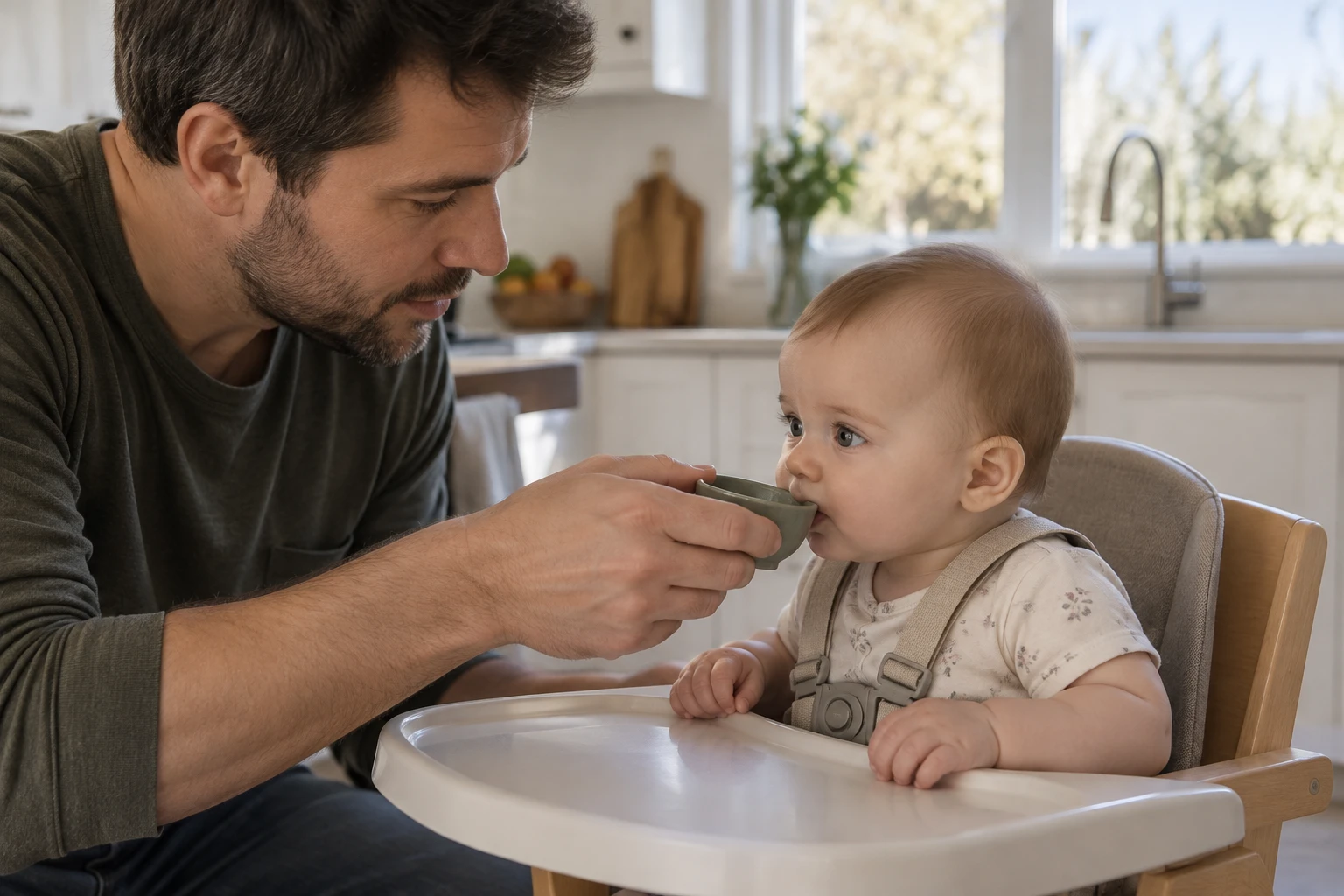
Imagine the first try as a shared moment at the table: an adult beside the chair, a cup within the adult’s reach, and a cloth ready for cleanup. Decide who is holding the cup before bringing it toward the baby. The photograph illustrates the position of the adult and cup; it is not a demonstration of how much liquid this particular baby needs. Use the safety guidance below, rather than copying the apparent fill level in any photograph.
Keep your baby upright, secure the high-chair harness, and stay with them during mealtimes. S06 · NHS
Offer a cup feed only when your baby is awake and ready to feed. S08 · The Dudley Group NHS Foundation Trust
Offer the rim, then let the baby respond
The important distinction in an open-cup demonstration is who controls the mouthful. An adult manages the cup, but the instruction is not to send a stream into the mouth. The Dudley NHS technique cited here was written for feeding expressed milk when direct breastfeeding is not possible. S08 · The Dudley Group NHS Foundation Trust We use its explicit positioning and no-pouring precautions, not maternity feeding volumes, as the safety reference. A family with an established clinical feeding plan should discuss the technique with their own clinician rather than replace that plan with a photograph. S01 · American Academy of Pediatrics
Rest the cup rim at the lower lip and tip it only enough for the liquid to touch the lips, allowing your baby to sip at their own pace. S08 · The Dudley Group NHS Foundation Trust
Go slowly. S08 · The Dudley Group NHS Foundation Trust
Never pour drinks into your baby’s mouth. S08 · The Dudley Group NHS Foundation Trust
If your baby closes their mouth or turns away, respect the cue rather than insisting they finish. S06 · NHS S14 · NHS
Straw practice without a performance test
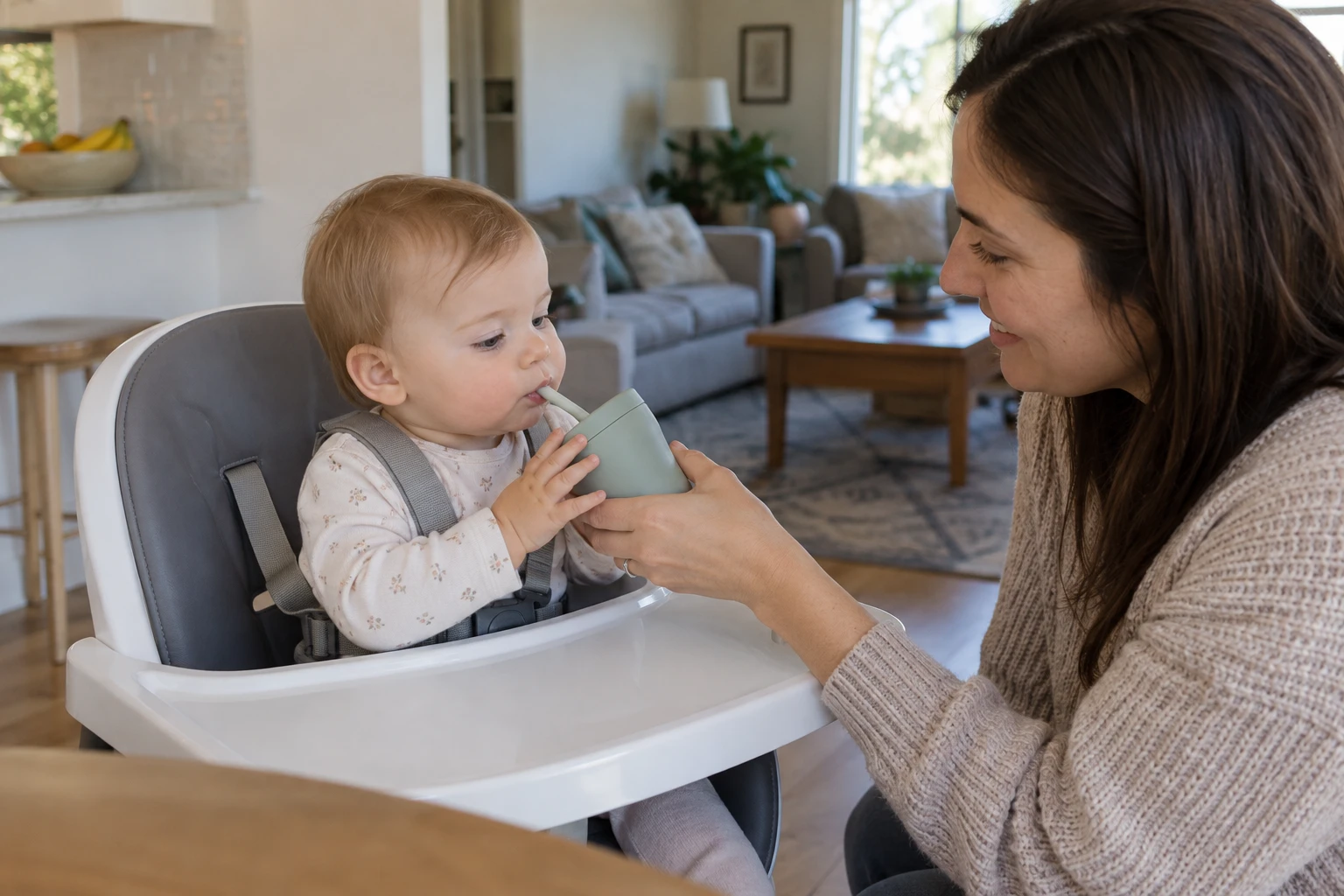
The straw is another cup option in the guidance, not an instruction to complete a separate training course. For your notes, describe the interaction plainly: “held the cup,” “touched the straw,” or “took a sip.” Those descriptions are more useful than calling an attempt good or bad. In particular, the words “used a straw” can hide very different observations. Did the baby bring it to their mouth, hold it between the lips, or actually drink? Keeping the description concrete leaves less for another caregiver to guess.
Between 6 and 9 months, babies may bite the cup rim or straw and spill liquid while beginning cup drinking. S04 · American Speech-Language-Hearing Association
Let your baby decide how much to take, and contact their clinician if you are concerned about intake. S14 · NHS S04 · American Speech-Language-Hearing Association
What belongs in the cup
Container size and daily intake are different measurements. A number printed on a large cup is its capacity, not a request to fill it or have the baby finish it. Likewise, the daily water amount below refers to a whole day, not one practice session. It does not describe the total of milk and water together. For a conversation with your clinician, name the drink, the amount offered, and what you think was actually swallowed, including uncertainty about spills.
For ages 6 to 12 months, the American Academy of Pediatrics lists 4–8 US fluid ounces of water a day, approximately 120–240 mL. S07 · American Academy of Pediatrics
Once solids begin around 6 months, the NHS advises offering sips of water with meals. S02 · NHS
Before 12 months, do not replace breast milk or infant formula with cow’s milk or plant-based drinks as the main drink. S02 · NHS
Do not change the recipe to make practice easier
A cup change is already one change to the routine. The mixing instructions on a formula container still apply when the prepared feed goes into a cup. S09 · Texas WIC, Texas Health and Human Services A useful family note is to write down the preparation time and feeding-start time separately; they answer different questions. In this guide, sweetening a drink, changing its concentration, or adding ingredients is not part of a cup-learning experiment. If someone suggests a modification, take that question to the clinician responsible for the feeding plan.
Do not add sugar, cereal or other ingredients to breast milk, formula or water in a bottle or training cup. S02 · NHS
Prepare formula with the exact water-to-powder ratio on its instructions; do not dilute it for cup practice. S09 · Texas WIC, Texas Health and Human Services
For prepared formula kept at room temperature, use it within 2 hours of preparation and within 1 hour after feeding starts, and discard leftovers after the feed. S09 · Texas WIC, Texas Health and Human Services S14 · NHS
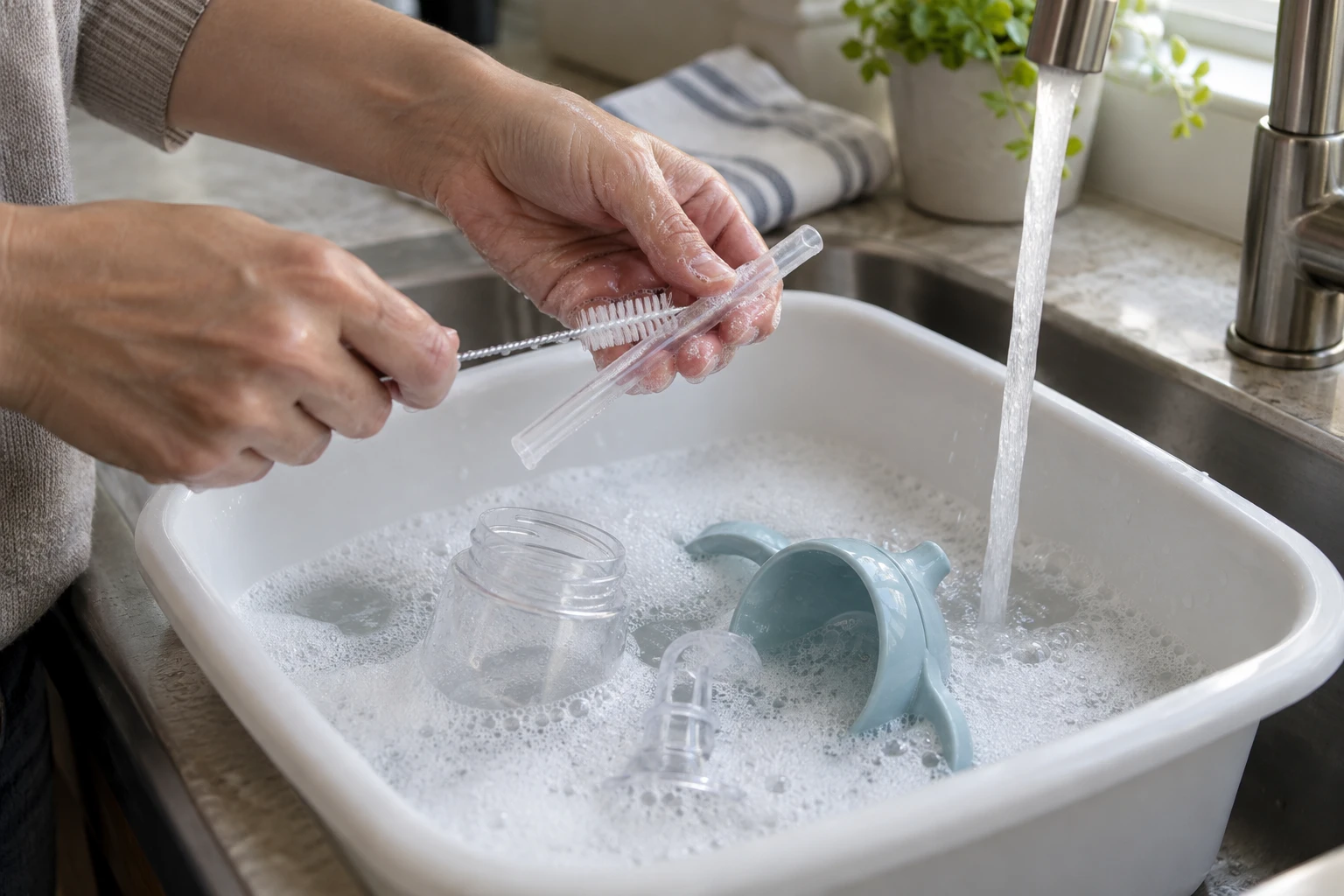
Cleaning is part of choosing a cup
Look at the cup as a collection of parts, not just the container you see on the table. The lid, straw and any seals need to be accounted for when following the manufacturer’s directions. A practical handoff is to show another caregiver the disassembled cup once, with the instructions nearby. A spare clean cup may be convenient, but this guide does not require a cupboard of equipment or a special machine. The basic question is whether your household can follow the cleaning method for this particular item.
Clean feeding items carefully after each use. S09 · Texas WIC, Texas Health and Human Services
Take feeding equipment apart, wash it in warm soapy water in a dedicated basin, rinse it, and let it air-dry completely. S09 · Texas WIC, Texas Health and Human Services
Texas WIC advises daily sanitizing for babies under 2 months, babies born prematurely, or babies with weakened immunity, using a method suitable for the item. S09 · Texas WIC, Texas Health and Human Services
Plan the bottle transition before it becomes a deadline
For a baby approaching the first birthday, make a simple map of the bottles currently offered: when, by whom, and in what setting. Mark which ones are meals and which are tied to a familiar settling routine. This is an editorial planning exercise, not an instruction to remove a prescribed feed. Bring the map to the next feeding discussion. It gives the clinician something specific to work with, and it lets the family agree on the same meaning of “we are starting to change the routine.”
Reduce bottle use gradually and offer comfort such as cuddles or stories as routines change. S01 · American Academy of Pediatrics
Do not put your baby to bed with a bottle. S05 · Children and Family Health Devon, NHS
Repeated, prolonged contact of teeth with milk, formula or sugary drinks can contribute to tooth decay. S01 · American Academy of Pediatrics

Spills, refusal and concerns are not the same entry
A wet bib describes a spill. “Turned away when offered the cup” describes a response. “Coughed during several drinks” describes a different observation. Do not merge all of these into “bad at cups” in your notes. Equally, a neat photograph or an apparently empty cup cannot tell the whole feeding story. The purpose of a record is to make your observation understandable, not to label the child. Include what happened during the drink and what happened immediately afterward.
Repeated coughing during drinks, a wet or gurgly voice after feeding, or poor weight gain are reasons to contact your baby’s clinician about feeding and swallowing. S10 · ASHA public education website, Helping You Communicate
A clinician can refer your baby to a professional trained in feeding and swallowing when assessment is needed. S10 · ASHA public education website, Helping You Communicate
When practice gives way to medical help
The next instructions describe care thresholds, not a diagnosis you must make at home. A cup log can help explain the history, but completing it is not a prerequisite for seeking help. The urgent dehydration advice comes from the NHS; families outside the UK should use their local urgent-care service. Emergency phone numbers vary by location, so keep the correct local contact available to every caregiver rather than copying a foreign number from a translated article.
Seek urgent medical advice if your baby has fewer wet diapers than usual, few or no tears when they cry, unusual drowsiness, or a sunken soft spot. S11 · NHS
With signs of dehydration, difficulty breathing, blue or grey skin or lips, or difficulty waking requires emergency help immediately. S11 · NHS
If your baby appears to choke and cannot cough effectively or breathe properly, shout for help and begin infant choking first aid immediately. S12 · NHS
If back blows and chest thrusts do not clear the blockage, call your local emergency number immediately even if your baby is still responsive, and continue infant choking first aid while help is coming. S12 · NHS
If a choking baby is or becomes unresponsive, call your local emergency number and start infant CPR following the dispatcher’s instructions. S12 · NHS
Get medical help even after the object comes out, because part may remain or the first aid may have caused an injury. S12 · NHS
Do not sweep inside your baby’s mouth with a finger when you cannot see an object to remove. S12 · NHS
A record another caregiver can actually use
Copy the fields below into whatever notebook or message system your family already uses. They are prompts, not medical targets. Leave a field blank if you did not observe it, and write “uncertain because some spilled” instead of inventing a swallowed volume. For example: “Lunch, open cup, water; adult held the cup; touched rim, then turned away; amount swallowed uncertain.” This is an invented example of wording, not a real patient story or a recommended amount. Add questions for the clinician in a separate line so a question is not mistaken for an agreed instruction.
Share the cup routine with everyone who feeds your baby. S01 · American Academy of Pediatrics
| Record field | Your observation |
|---|---|
| Date / time / caregiver | ________________ |
| Cup and drink | ________________ |
| Position and adult assistance | ________________ |
| What happened during and after drinking | ________________ |
| Amount offered / swallowed / spilled, if known | ________________ |
| Usual feeds and wet-diaper observations | ________________ |
| Question or agreed next step | ________________ |
Frequently asked questions
Is a spouted training cup a required step?
A spouted training cup is optional, and a non-spill valve requires sucking rather than free-flow sipping. S01 · American Academy of Pediatrics S05 · Children and Family Health Devon, NHS
Must my baby stop breastfeeding to use a cup?
Cup practice does not require stopping breastfeeding; breastfeeding can continue for as long as parent and child want. S15 · American Academy of Pediatrics S06 · NHS
Does biting the straw mean practice has failed?
Between 6 and 9 months, babies may bite the cup rim or straw and spill liquid while beginning cup drinking. S04 · American Speech-Language-Hearing Association
What if my baby coughs repeatedly while drinking?
Repeated coughing during drinks, a wet or gurgly voice after feeding, or poor weight gain are reasons to contact your baby’s clinician about feeding and swallowing. S10 · ASHA public education website, Helping You Communicate
Official sources
- S01 · From Bottle to Cup: Helping Your Child Make a Healthy Transition — American Academy of Pediatrics
- S02 · Drinks and cups for babies and young children — NHS
- S04 · Feeding and Swallowing Milestones: Birth to 1 Year — American Speech-Language-Hearing Association
- S05 · Cups bottles and dummies - tips and advice — Children and Family Health Devon, NHS
- S06 · Your baby’s first solid foods — NHS
- S07 · Recommended Drinks for Children Age 5 & Younger — American Academy of Pediatrics
- S08 · Information on feeding your baby – hand expression and cup feeding — The Dudley Group NHS Foundation Trust
- S09 · How to Mix Infant Formula — Texas WIC, Texas Health and Human Services
- S10 · Feeding and Swallowing Disorders in Children — ASHA public education website, Helping You Communicate
- S11 · Dehydration — NHS
- S12 · How to stop a child from choking — NHS
- S14 · Bottle feeding advice — NHS
- S15 · Weaning Your Baby — American Academy of Pediatrics
This is parent education, not an individual diagnosis or treatment plan. No clinician review is claimed. For your baby’s specific feeding needs, use the plan agreed with their clinician. S01 · American Academy of Pediatrics The photographs are generated illustrations of everyday settings, not documented patient care.