My Baby Was Exposed to Whooping Cough. What Now?

Do not wait for your baby to cough. Exposure decisions depend on dates, age, and closeness. One same-day phone call can start the right assessment while your baby still looks well.
SUMMARY
Call your pediatrician or local health department today. Share your baby’s age, exposure date, and the patient’s cough-start date. Keep the sick person away from your baby. CDC supports preventive-antibiotic assessment within 21 days for high-risk infants and household contacts. Seek emergency help for breathing pauses, blue color, or severe breathing difficulty.
Step 1: separate first
Move the infected or coughing person away from the baby. Avoid close indoor contact, feeding, holding, and kissing. Improve ventilation where practical. Use masks and cough etiquette according to local public-health advice.
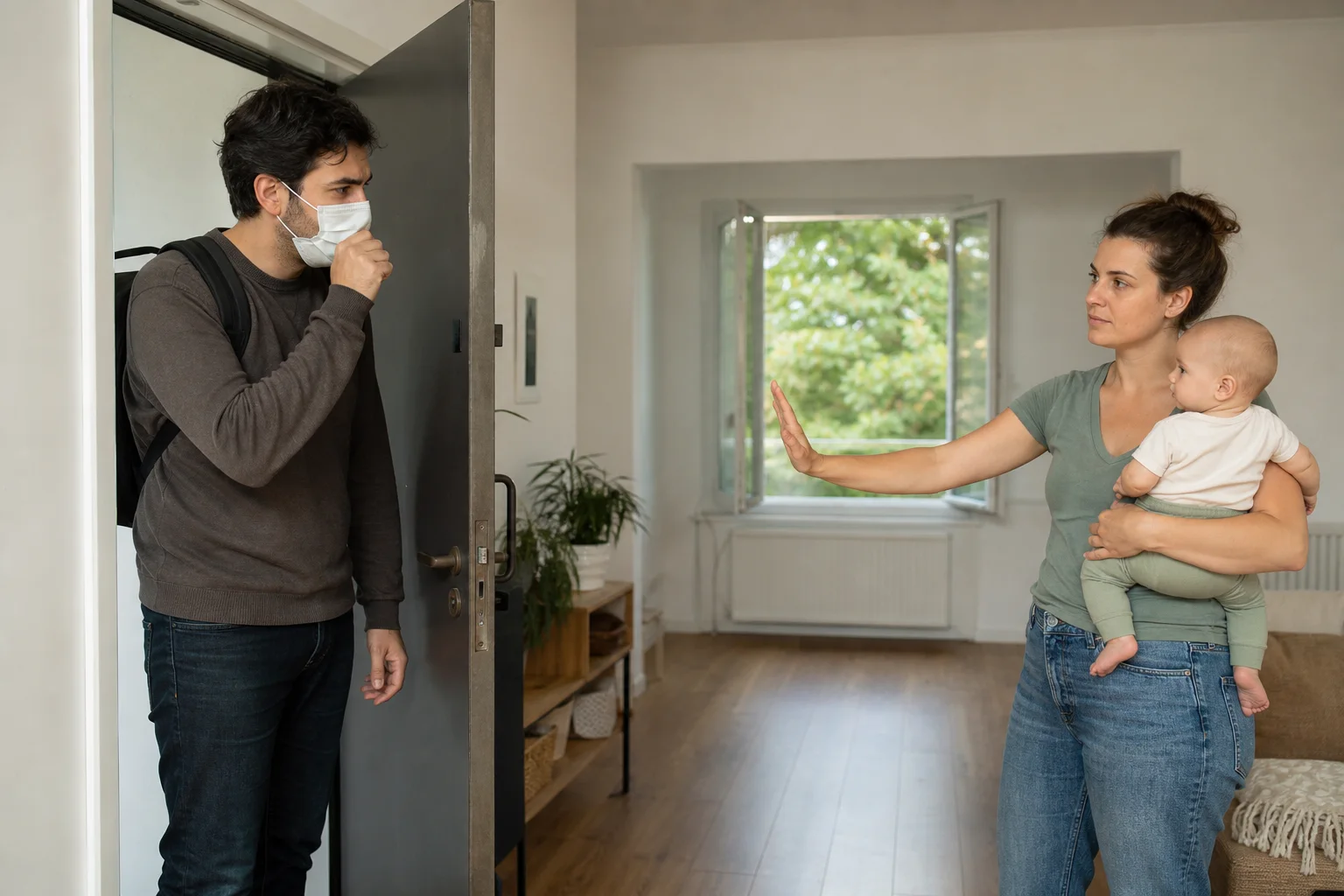
Do not rely on vaccination status alone. Vaccinated people can still become infected and spread pertussis. Their symptoms may be milder, which can make the infection easier to miss.
Step 2: make one same-day call
Call your pediatrician or public-health service today. Do this even when your baby has no symptoms. Infants under 12 months have higher complication risk. Risk is greatest under four months.
Give the office four details:
- Your baby’s exact age and birth history.
- The most recent close-contact date.
- The infected person’s cough-start date.
- Your baby’s DTaP doses and pregnancy Tdap history.
These details help clinicians define the exposure and timing. They also help determine whether testing, monitoring, or preventive antibiotics are appropriate. Do not start leftover medicine or share another person’s prescription.
Why 21 days matters
Pertussis symptoms commonly begin five to ten days after exposure. They can begin up to three weeks later. That creates a 21-day monitoring window.
CDC supports preventive antibiotics for high-risk people within 21 days of exposure. It also supports them for asymptomatic household contacts within 21 days of the patient’s cough onset. The goal is preventing serious disease in vulnerable people.
This does not mean every brief contact needs medicine. Public-health teams consider proximity, duration, symptoms, and local conditions. Your baby’s clinician should make that decision.
Step 3: watch for early changes
Monitor your baby for 21 days after the last exposure. Early symptoms may include a runny nose, mild cough, or low fever. Babies may have apnea with little coughing. Watch breathing, color, feeding, alertness, and wet diapers.
Call promptly if symptoms appear. Call before arriving at a clinic. Tell staff about the pertussis exposure. They can protect other infants and arrange the safest assessment.
Emergency signs
- Breathing stops or pauses.
- Lips, tongue, or face turn blue or gray.
- Breathing becomes severely difficult.
- Your baby becomes limp or difficult to wake.
These signs need emergency help now. Do not wait for a callback. Do not wait for coughing fits or test results.
What happens to the sick household member?
Effective antibiotics usually end infectiousness after five completed days. Without treatment, infectiousness can continue for about three weeks after coughing fits begin. Follow the clinician’s exact isolation instructions.
The cough can continue after infectiousness ends. That does not automatically mean treatment failed. Damaged airways can take weeks to recover. Only the treating clinician should determine when contact can resume.
What about vaccines after exposure?
Keep your baby’s DTaP series on schedule. Vaccination does not treat a current infection. It also does not replace preventive-antibiotic assessment after a significant exposure. However, on-time doses protect against future illness and severe outcomes.
Routine DTaP doses occur at two, four, and six months. Further doses follow at 15–18 months and 4–6 years. Catch-up timing depends on age and previous doses. Ask your pediatrician for the correct schedule.
Frequently asked questions
My baby was only near the person once. Should I call?
Yes. Describe the distance, setting, and duration. A clinician can decide whether it counts as close contact.
The infected person started antibiotics today. Can they hold my baby?
Not yet. Effective treatment generally needs five completed days. Follow their clinician’s isolation instructions.
My baby looks well after 10 days. Is monitoring finished?
Not necessarily. Symptoms can begin up to 21 days after exposure. Follow your clinician’s monitoring dates.
For symptoms, read why babies may not whoop. See the complete parent guide for prevention and treatment basics.
Sources
This article is general information and is not medical advice. Ask your pediatrician or public-health service about a specific exposure.