Long Car Rides With a Baby
A long drive is safer when stops are part of the itinerary, not an improvised response to distress. Check the seat first, travel with another attentive adult when possible, and stop completely before feeding or repositioning the baby.
Summary
Plan to stop and take the baby out of the seat at least every two hours, following UK NHS guidance, or sooner if the manufacturer or clinician advises. Stop earlier for any breathing, posture, temperature, feeding, or distress concern. Longer nighttime feeding-stop intervals in AAP travel advice are not a guarantee of safe continuous time in a car seat. Never breastfeed or bottle-feed in a moving car. On arrival, move a sleeping baby from the car seat to a firm, flat approved sleep surface. Use thin clothing under the harness and place warmth over the secured straps. Remove the baby whenever adults leave the parked vehicle.
Plan stops and safe sleep
Car seats are travel restraints, not routine sleep spaces outside the vehicle. A baby may doze while riding in a correctly installed seat, but the baby should be moved to a firm, flat, approved sleep surface after arrival. For longer trips, plan safe places to stop and remove the baby for care. UK NHS guidance advises no more than two hours in a car seat at a time. Plan breaks at least that often and follow any shorter limit from the seat manufacturer or the baby's clinician. AAP travel guidance lists two-to-three-hour daytime and four-to-six-hour nighttime care breaks; those are not universal safe limits for continuous car-seat use. Stop sooner for any breathing, posture, temperature, feeding, or distress concern.
Feed and reposition only after parking
Never breastfeed, bottle-feed, unbuckle, or reposition a baby while the vehicle is moving. The driver should not reach into the back seat. Pull over at a safe location, stop fully, and attend to the baby. Another adult in the back can observe the baby's posture and needs, but cannot make unsafe adjustments during motion. Keep needed supplies accessible for the stop, not loose where they can become projectiles. Resume travel only after the baby is correctly buckled and the driver can focus on driving.
Use clear stop and emergency rules
Stop promptly for chin-to-chest slumping, difficult or noisy breathing, color change, repeated vomiting, overheating, unusual limpness or sleepiness, poor feeding, or distress that does not settle. Contact the pediatrician for persistent symptoms or special travel questions involving prematurity, low birth weight, airway conditions, casts, or medical equipment. Call emergency services for severe breathing trouble, blue or gray color, seizure, marked unresponsiveness, or inability to wake. Never leave a baby unattended in a parked car, even briefly.
Keep clothing thin under the harness
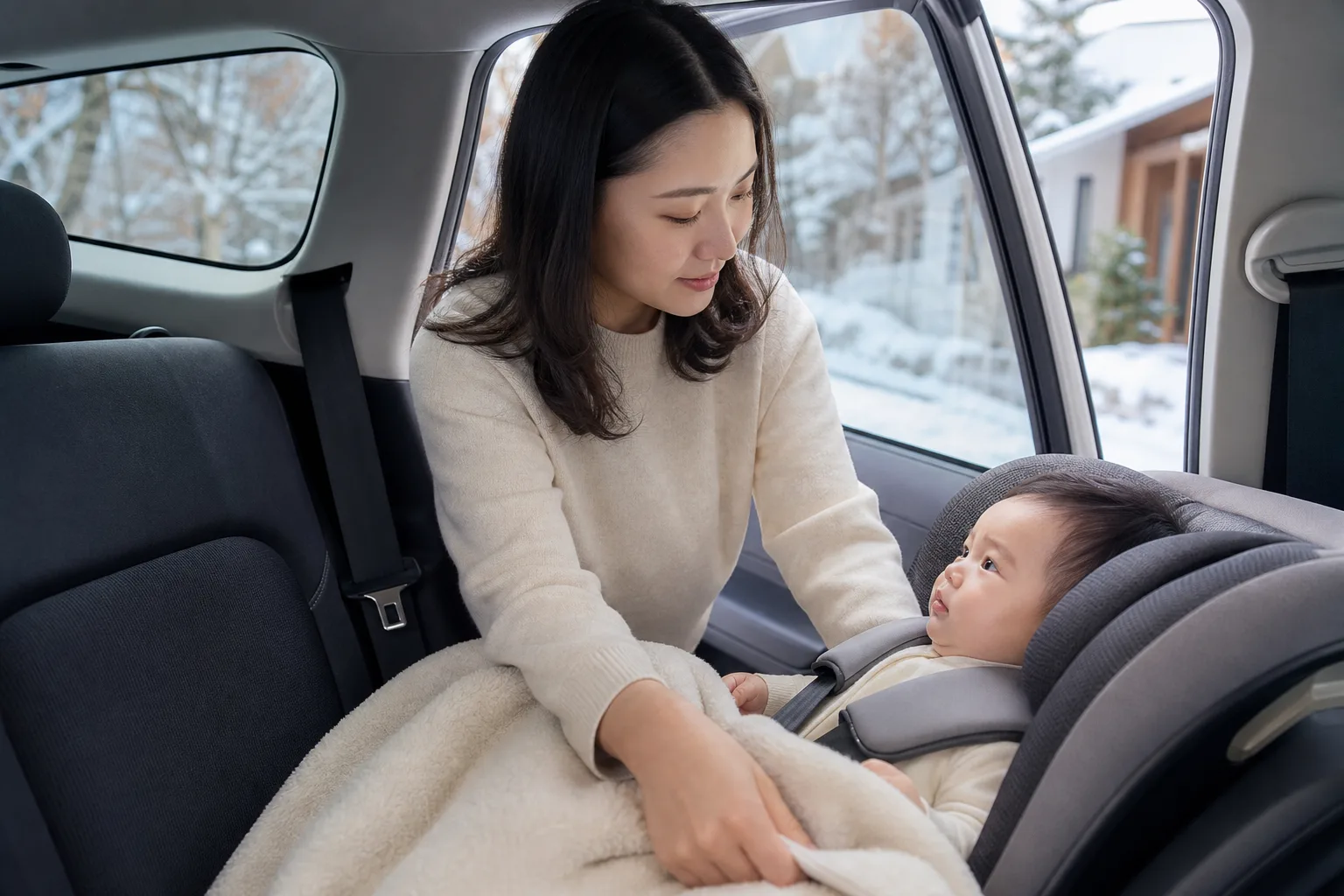
Puffy coats, thick snowsuits, and bulky blankets can create hidden slack. Dress the baby in thin fitted layers, buckle and tighten the harness, then place a blanket or coat over the secured straps if warmth is needed. Keep all fabric away from the face and airway. Check that the baby is not overheating, and remove outer warmth as the vehicle cabin heats. Never loosen the harness to accommodate a bulky layer. A cold-weather cover must not pass behind the baby or interfere with the harness unless the seat manufacturer approves it.