Baby Ear Cleaning: What to Leave Alone

Baby ear cleaning starts with a small question: are you washing the skin you can see, or trying to take something out of the ear canal? This guide is for adult caregivers of babies under one year, including newborns. It explains everyday washing, the role of earwax, what to leave to a clinician, and how to describe a concern without having to diagnose it yourself.
SUMMARY
Wipe only outside the ear. S1
Never put cotton swabs inside a baby’s ears. S1
Earwax usually moves out of the ear canal on its own. S6
For ear pain or drainage, contact a clinician. S7
The care thresholds below explain when that call is urgent. The short video teaches external cleaning only; it is not a complete symptom assessment.
Understand what you are cleaning
The ear canal leads to the eardrum, which separates it from the middle ear. S9
Earwax is made by glands in the outer third of the ear canal. S6
Earwax helps protect and lubricate the skin of the ear canal. S6
In this guide, “outside” means the visible ear and the skin behind it. It does not mean the part of the opening you can reach with a small tool. Keep that wording in mind when reading a product label or explaining the routine to another caregiver. A photograph of a clean-looking ear is not a target for how an ear canal should look. The everyday task described here ends at the outside surface.
Earwax is part of the ear, not a cleaning score

Having earwax is not a sign of poor hygiene. S2
Fresh earwax can be golden yellow, while older wax may become darker and drier. S2
A clinician may need to remove wax when it causes symptoms or prevents a necessary ear examination. S6
Seeing wax can make it tempting to finish the job with one more wipe. A more useful question is what you are actually concerned about: the appearance of a little wax, a change in the baby's behavior, or something that happened during cleaning. Those are different questions for a medical conversation. There is no need to present an empty-looking ear as proof of attentive care. The amount you can see is an observation to describe, not a household performance measure.
Choose the moment and prepare the space
Choose a time when your baby is awake and content for gentle washing. S1
Babies do not need a full bath every day; washing selected areas is an alternative. S1

Prepare warm water, cotton wool or a soft washcloth, and a soft towel within reach. S1 S5
You can hold your baby on your knee or lay them on a changing mat for this wash. S1
Before starting, picture the whole task with the supplies already in place. Where will the used cloth go? Where is the dry towel? Which adult is holding the baby? These are practical planning questions, not a requirement for special equipment. If two adults share care, agree on the words “around and behind” before either begins. If you are unsure what a clinician meant by cleaning an ear, ask them to demonstrate on the outside rather than guessing from the name of a tool.
A short routine for the visible skin
The preparation above comes first. The following steps describe the external washing sequence, with a clear stopping point. They are not instructions for loosening or extracting a plug of wax.
Dampen the cloth or cotton wool with warm water, squeeze out excess water, and gently wipe around and behind the ears. S5
Use a fresh piece of cotton wool when cleaning around your baby’s ears. S1
Gently pat the outer skin dry, including behind the ears. S5
For example, a handoff note might read, “Washed around the left and right ears and dried behind them; nothing placed inside.” That tells the next adult exactly what was done. “Cleaned the ears” leaves more room for different interpretations. If you want a demonstration at a routine visit, bring the cloth you use and ask the clinician to show the boundary between the visible skin and the opening. You do not need to arrive with the wax already removed. S6
What changes during a bath?
Never leave a baby alone in the bath, even for a moment. S1
The ear-care sequence can sit within your usual washing routine, but organizing the room still matters. A towel left across the room is a planning problem to solve before the baby is in the bath. This guide does not prescribe a separate daily ear-cleaning appointment, a count of wiping strokes, or a required amount of wax to remove. Keep the question specific: “Are we washing the outside skin, or have we started trying to clear the canal?” The latter is outside this routine.
Why a cotton swab is not a smaller washcloth
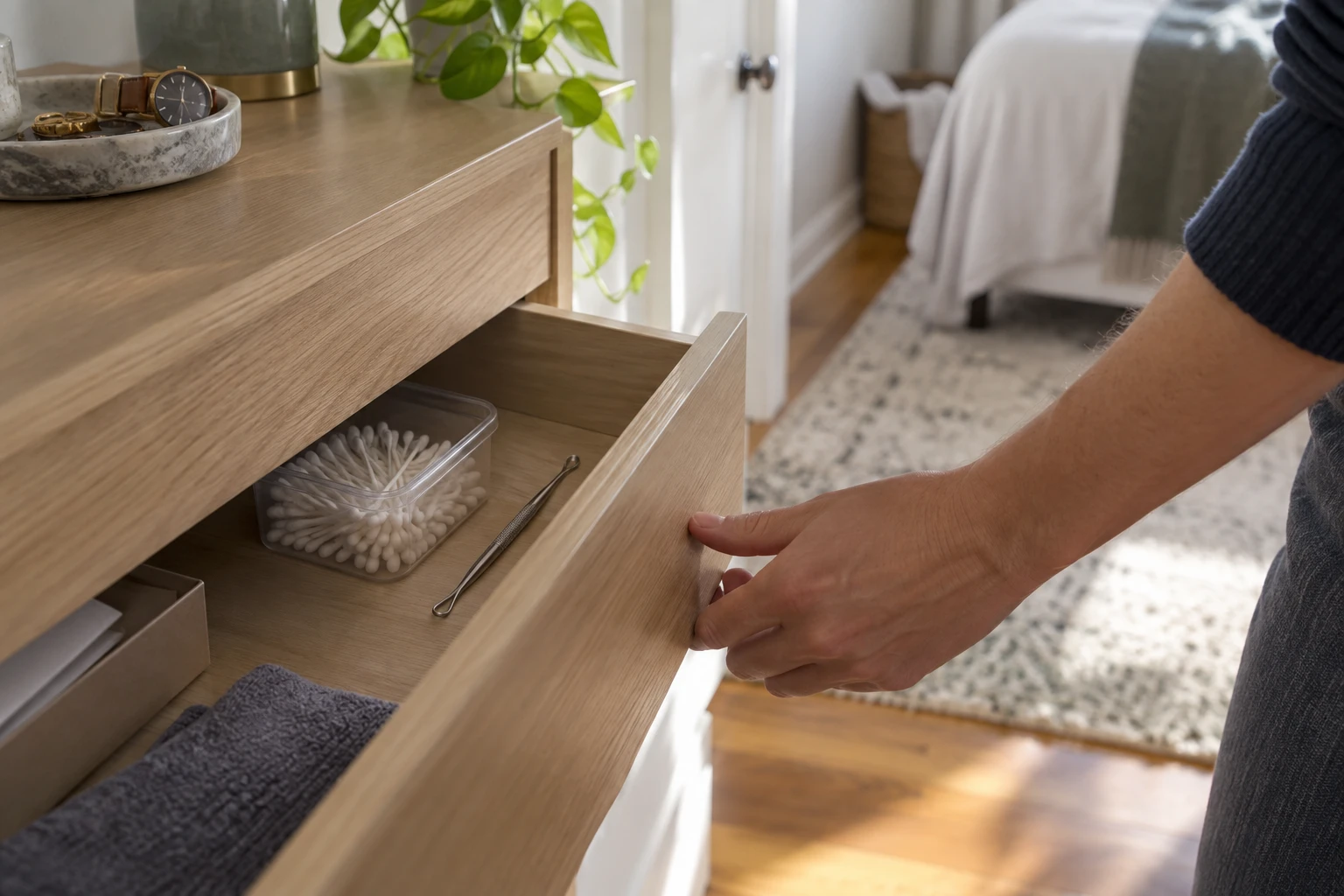
A cotton swab can push earwax deeper and pack it into a plug. S2
Cotton swabs and other objects inserted into the ear can injure the canal or eardrum. S7
A label such as “baby,” “safety,” or “soft tip” does not change the boundary used in this guide: no object goes inside the ear. S1 S7 The same household rule covers a fingernail, a scoop, a camera-equipped ear pick, and a twisted corner used to reach inward. This is an application of the no-insertion advice above, not a claim that every product has been separately tested. Keep the conversation about where the object goes rather than whether its packaging looks gentle.
More cleaning is not the goal
Too much ear cleaning can irritate the canal and increase the chance of wax impaction. S7
Do not use ear candles, because they do not remove earwax and can cause serious injury. S7
If someone else offers to clear the baby's ears, a simple explanation can avoid a debate: “We wash the outside; the clinician handles any question about a blockage.” It is also reasonable to ask what they mean by “clear.” Do they mean wiping skin behind the ear, or putting a tool through the opening? Naming the action makes the decision concrete. This guide offers no technique for scraping, suctioning, or burning anything near a baby's ear.
Drops, oils and rinses need an infant-specific decision
For children under 6 years, use earwax drops or ear flushing only if their doctor advises it. S2
If your child has ear tubes, a perforated eardrum, or previous ear surgery, do not try to remove wax at home. S2
You may encounter general earwax pages that discuss oils, peroxide, syringes, or softening drops. Read the age and medical-history conditions before treating that as advice for your baby. The under-six restriction quoted here includes every infant in this guide. We do not provide a home mixture, a number of drops, or a flushing method. If a clinician recommends a product for your child, the useful questions are its exact name, which ear it is for, how to use it, and what follow-up they want.
Pulling an ear does not explain the cause
Ear pulling can reflect a baby exploring their ears, wax buildup, or an ear infection, so that behavior alone does not identify the cause. S8
A middle ear infection involves inflammation and fluid behind the eardrum, rather than simply visible wax at the opening. S9
Separate an observation from an explanation. “She pulled her right ear after waking” describes an event. “Her ear is full of wax” adds a conclusion that the event does not establish. You can bring the first sentence to a clinician without supplying the second. In the same way, a visible bit of wax and an unsettled evening can be recorded as two observations rather than connected into a diagnosis. This leaves room for the examination to answer the medical question.
When routine cleaning should become a medical conversation

If you suspect an ear infection in a baby under 12 months, arrange a medical assessment. S3
For a baby with an earwax problem but no urgent symptoms, contact their clinician during office hours. S2
A clinician can examine the eardrum with an otoscope, a small instrument with a light. S9
For a nonurgent wax concern, a useful opening is, “I can see material at the opening and I am unsure whether it needs attention.” Mention what prompted the question and whether anything was put inside the ear. A visit is also a chance to ask what can be left alone and what a future change would look like. You do not need to know the name of a condition before asking for help, and this article does not decide whether your baby needs wax removal.
Signs that need help now
Use the conditions below as reasons to contact care, not as a checklist that must be completed before calling. These are selected warning signs relevant to an ear-cleaning concern, not an exhaustive assessment of a sick baby.
Seek medical care now for ear pain or bleeding after a cotton swab or another object entered the ear. S2
With symptoms of an ear infection, swelling around the ear, fluid draining out, or new hearing changes need urgent medical advice now. S3
A baby under 12 months with pain in both ears needs urgent medical advice now. S3
If an object entered the ear, describe the object and what happened in plain language. “A cotton swab went in and I saw blood” is enough to explain the event. There is no need to work out how far it went before making contact. For swelling or fluid, explain where you noticed it and when. The urgent advice here follows the NHS and Seattle Children's guidance linked beside each sentence; use the urgent medical service available where you live.
Fever has its own age thresholds
For a baby under 3 months, a temperature of 38°C or higher, or suspected fever, needs urgent medical advice now. S4
For a baby aged 3 to 6 months, a temperature of 39°C or higher, or suspected fever, needs urgent medical advice now. S4
A digital thermometer in the armpit can be used to check a young child’s temperature. S4
Call your local emergency number if your baby has difficulty breathing or is unusually drowsy and hard to wake. S4
The temperature numbers belong with the baby's exact age, so include both when speaking to a service. A note that says only “a little warm” loses that context. When recording a reading, include the time, the value, the unit, and how it was measured. The threshold statements above preserve the NHS wording about suspected fever as well as measured temperature. They are not a reason to postpone a call until a particular thermometer reading appears. S4
A record you can read aloud

This blank template is an editorial aid for organizing a conversation, not a diagnostic score. Use ordinary descriptions, and leave an item blank if you do not know the answer. There is no pass or fail and no required total.
| Field | What to write |
|---|---|
| Baby and timing | Age; date and time first noticed; left ear, right ear, or both. |
| Visible observation | Where the material or skin change is; any fluid or blood noticed. |
| Behavior | What the baby did; apparent pain; any change in response to ordinary sounds. |
| Temperature | Reading, unit, time and measurement method, if taken. |
| What happened | External washing; any object or product used; when it was used. |
| History and plan | Ear tubes or surgery; who you contacted; the advice and follow-up given. |
A practice example might begin, “Right ear, first noticed after the morning wash; outside wiped with water and a cloth.” Add only details that actually happened to your baby. Do not borrow a temperature or symptom from an example. If another adult makes the call, the same note can be read without translating “looked odd” into a medical label. For a shared daily record, our daycare handoff guide offers a place to organize observations.
Questions to bring to an appointment
You can ask: “Does this wax need any attention?” “Can you see what you need to examine?” “Could you show me where external washing stops?” “Does my baby's ear history change the plan?” If a treatment is recommended, ask for the instructions in a form the other caregiver can read too. These are conversation prompts, not demands for a procedure. The answer may be a demonstration, an examination, an individualized plan, or reassurance after assessment.
Frequently asked questions
Should newborn earwax be removed just because I can see it?
A clinician may need to remove wax when it causes symptoms or prevents a necessary ear examination. S6
Visibility by itself is not the removal test described here. If appearance is your only concern, describe it at a routine conversation rather than setting a goal to make the opening look empty.
Are infant cotton swabs allowed inside the ear?
Never put cotton swabs inside a baby’s ears. S1
The guide's rule is about insertion, so a different label does not create an exception.
Can I use the drops that another family uses?
For children under 6 years, use earwax drops or ear flushing only if their doctor advises it. S2
A recommendation made for another person is not an instruction for your baby. S2 Ask for an infant-specific plan rather than transferring someone else's product and directions.
What if cleaning caused pain or blood?
Seek medical care now for ear pain or bleeding after a cotton swab or another object entered the ear. S2
When you call, identify the object and the sequence of events. The purpose is to obtain care, not to decide how serious the injury is by looking into the ear yourself.
Keep the routine understandable for every caregiver
Our family hand-hygiene guide covers the wider care routine, and the baby nail-trimming guide addresses another small grooming task. Each has its own instructions; neither changes the boundary for ears. For this task, an agreed phrase, a cloth and towel, and a clear account of any concern are easier to share than a collection of home earwax-removal techniques.
Official sources
- NHS: Washing and bathing your baby
- Seattle Children’s: Earwax Buildup
- NHS: Ear infections
- NHS: High temperature (fever) in children
- Pregnancy, Birth and Baby / Healthdirect Australia: Cleaning your baby’s ears, eyes and nose
- American Academy of Otolaryngology–Head and Neck Surgery Foundation: Earwax (Cerumen Impaction)
- American Academy of Otolaryngology–Head and Neck Surgery Foundation: Dos and Don’ts of Earwax (Cerumen)
- Seattle Children’s: Ear - Pulling At or Rubbing
- National Institute on Deafness and Other Communication Disorders: Ear Infections in Children
This article provides general parent education, not a diagnosis, prescription or individual medical assessment. It was prepared by the OhMyBaby Editorial Team and has not been individually reviewed by a named clinician. The photographs are newly AI-generated educational scenes, not images of a diagnosed condition. The linked official guidance and your child's clinical advice supply the medical context.