Cradle cap: Gentle care and warning signs

A yellow scalp patch can be unsettling. Start with how your baby is doing, then choose a gentle care plan. This guide separates ordinary scale care from product decisions and the signs that need medical attention.
SUMMARY
Do not pick cradle cap. NHS · American Academy of Dermatology Use fragrance-free baby shampoo. NHS · American Academy of Dermatology Gently brush only loose flakes. American Academy of Dermatology · Healthdirect Australia Contact your baby's clinician for bleeding, fluid, or swelling. NHS
Start with the baby, then look at the scalp
Cradle cap is greasy scalp scaling from infant seborrheic dermatitis, often beginning in the first weeks of life. American Academy of Pediatrics · Healthdirect Australia Finding a yellow patch can make a caregiver want to clean it immediately. First describe what you can actually see: a few dry flakes, a greasy patch, or fluid on the skin. Keep the baby’s age beside that description. This guide covers babies under one year; it does not turn every yellow crust into a diagnosis.
Uncomplicated cradle cap usually causes neither pain nor itching. Seattle Children’s Ask whether the baby seems comfortable before planning a wash. A photograph of flakes alone leaves out that useful context. If you are worried about feeding, waking or breathing, use the care thresholds below instead of spending the next hour trying to make the scalp look tidy.
What the scales do—and do not—tell you
Typical cradle cap is not contagious and does not mean a baby has been poorly washed. Healthdirect Australia · HealthLink BC There is no need to explain the patch as a failure by whoever gave the last bath. When several adults share care, agree on neutral words such as “small patch at the crown.” That makes the next conversation about observation and care, without asking anyone to defend their housekeeping.
Its precise cause remains uncertain; skin oils and normally present yeast may play a part. DermNet · American Academy of Pediatrics That uncertainty matters when a product claims to remove the single “root cause.” A bottle, brush set or home recipe does not explain which condition your baby has. Write down a proposed product’s name and discuss it if needed; do not build a complicated routine around a confident advertisement.
Decide what counts as enough
Mild cradle cap can be left to settle without removing every scale. HealthLink BC · Cochrane A sensible household goal is a comfortable baby and a simple routine everyone understands. You do not need a before-and-after photograph with a completely bare scalp. Decide in advance that a patch can remain after the wash. This makes it easier to put the brush down instead of adding “just one more pass.”
Do not pick cradle cap. NHS · American Academy of Dermatology For this guide, “remove” means allowing material that is already loose to come away. It does not mean lifting a fixed edge with a fingernail, dragging a tool under a crust or peeling a whole patch. Put tweezers and scraping tools outside the care setup so another caregiver cannot mistake them for supplies.
Picking or scratching the crusts can increase the risk of infection. American Academy of Dermatology · Healthdirect Australia This is why the stopping point is part of the care plan. If the material does not move with a gentle wash or light brush, leave it attached. American Academy of Dermatology · Healthdirect Australia Tell the next caregiver that you intentionally left it alone, so they do not interpret the remaining patch as an unfinished job.
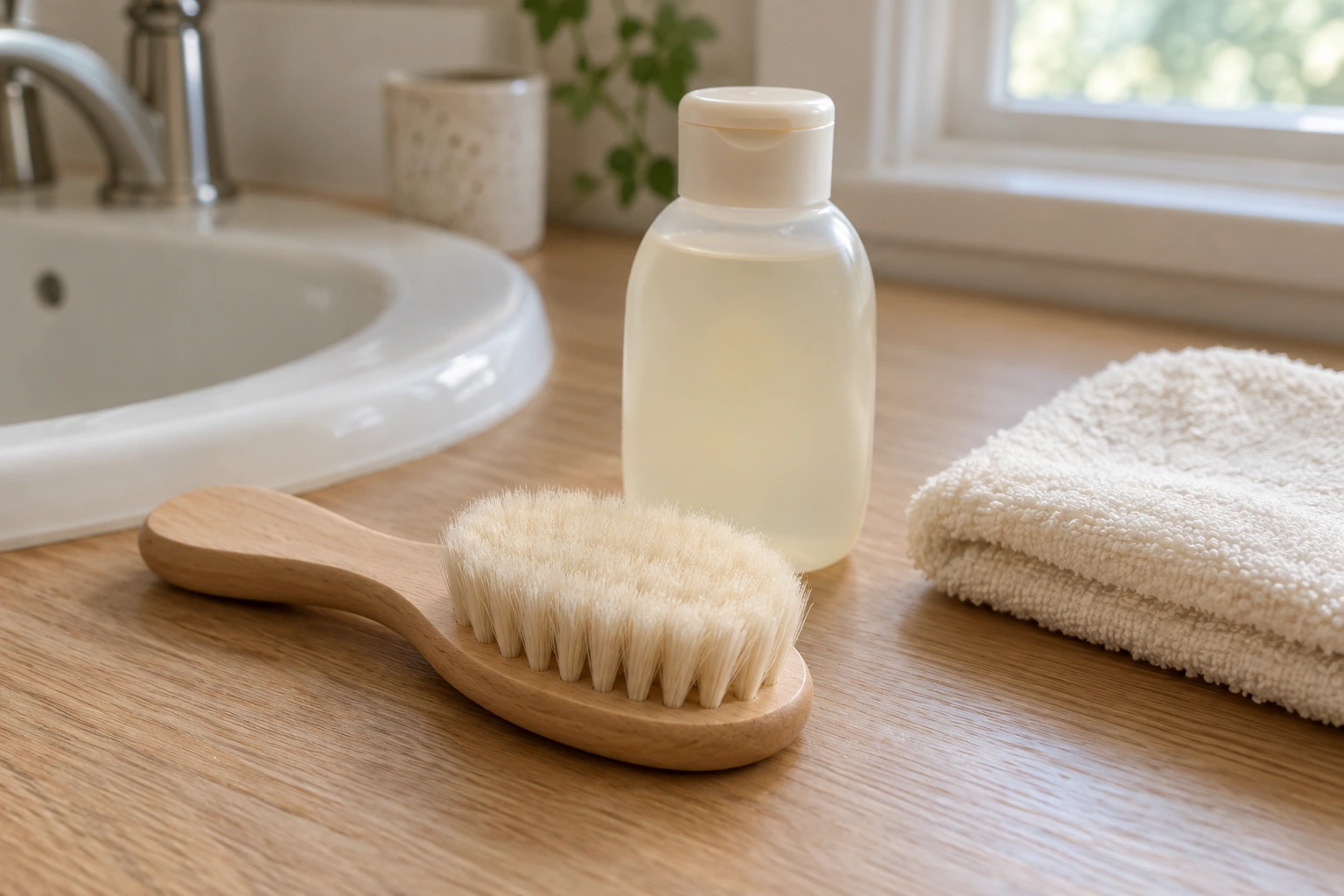
Prepare a small, ordinary care setup
Use fragrance-free baby shampoo. NHS · American Academy of Dermatology Set out the product you intend to use, a clean soft baby brush and a towel before picking up the baby. Read the actual bottle rather than relying on its color or the word “gentle” on an online listing. If two caregivers use different products, put the agreed bottle in one obvious place.
Use warm, not hot, water; support the head and shoulders and never leave a baby alone while washing. NHS · HealthLink BC Choose a time when you can give the task your attention. Let a phone call wait. If you need an item that is out of reach, stop the task and take the baby with you. HealthLink BC · NHS There is no scalp-care deadline that makes leaving a baby beside water a useful shortcut.
For a newborn whose cord stump has not fallen off and healed, AAD guidance favors sponge bathing before tub baths. American Academy of Dermatology Use the bathing arrangement your maternity or pediatric team has shown you. Scalp care can be discussed within that arrangement; it is not a reason to improvise a different bathing method. Ask for a demonstration if supporting the baby while washing the crown still feels awkward.
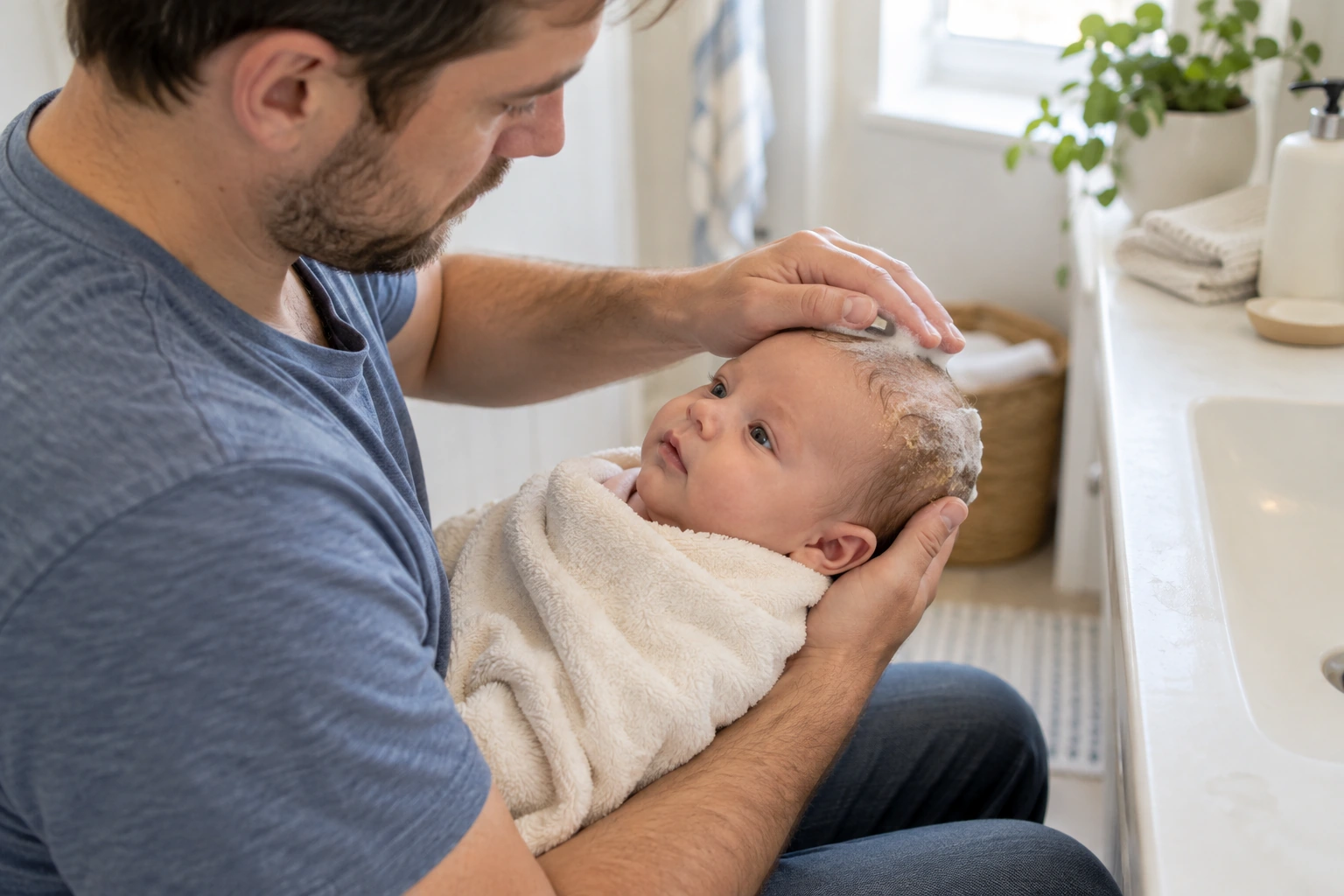
Wash gently, then leave attached patches alone
Gently brush only loose flakes. American Academy of Dermatology · Healthdirect Australia Use the brush as a light finishing step, following the baby’s usual washing routine. If an edge stays fixed, count that as a reason to leave it for another day. Do not turn the task into a test of pressure or brush stiffness. The number of flakes on the brush is not a score.
Rinse shampoo out thoroughly and gently towel-dry the scalp. Nationwide Children’s Hospital · HealthLink BC Finish the wash without returning to each remaining patch. Put the baby into the next ordinary part of the routine, whether that is getting dressed or being held. Note what you used once, instead of checking the scalp repeatedly to see whether the session “worked.”
Clean the soft brush with soap and water to remove oil and flakes. Nationwide Children’s Hospital Leave the cleaned brush with the agreed supplies so the next caregiver knows it is ready. Keep the cleaning task separate from touching the baby’s scalp. A small written reminder is enough; a new kit or a collection of different brushes is not required to follow these steps.
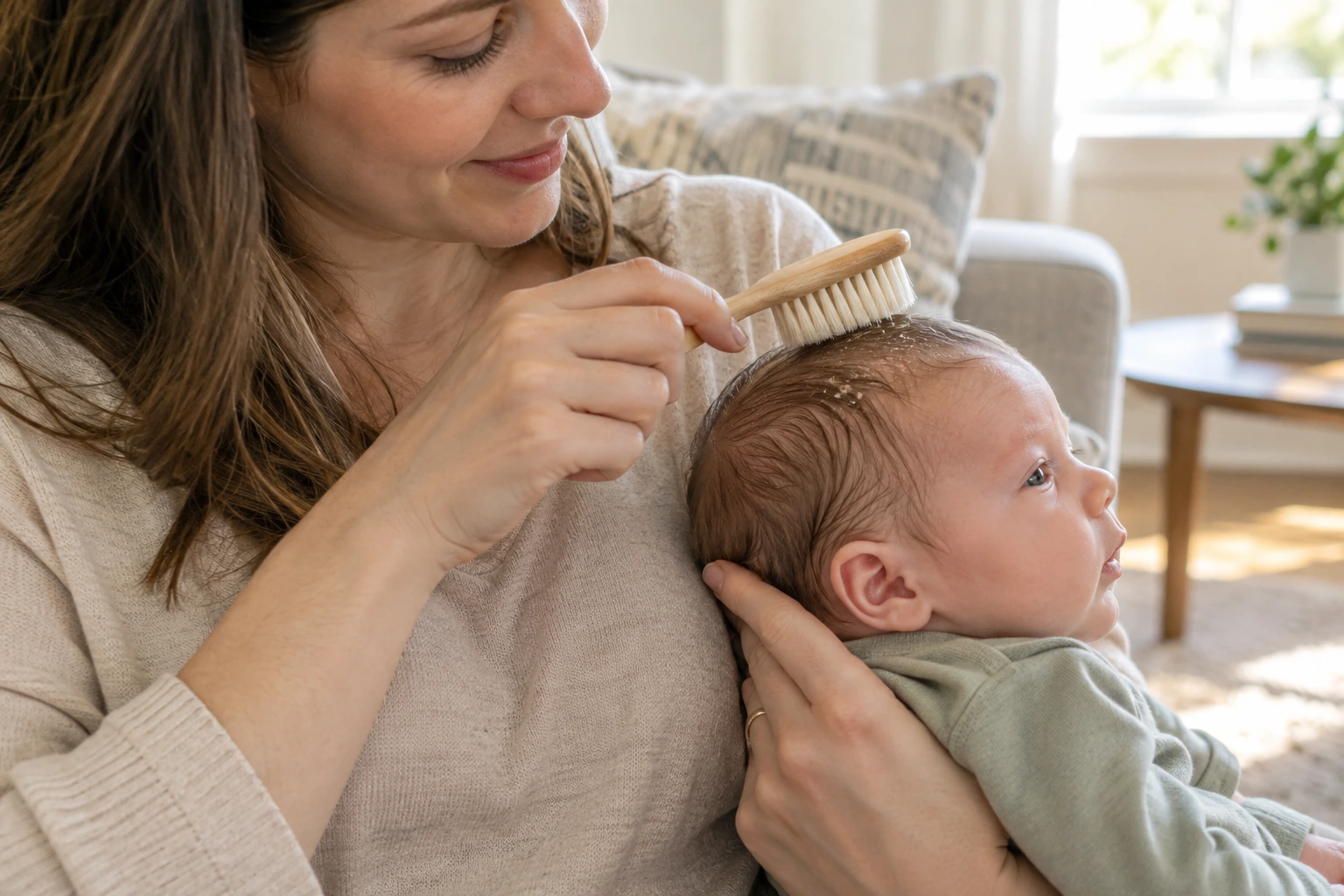
How often, and what if scales return?
The AAP suggests washing every other day for many babies, but eczema or another skin condition calls for an individual washing plan. American Academy of Pediatrics Treat that interval as one published approach, not a challenge to wash every baby on the same calendar. In your notes, write the plan actually agreed for your child. Keep scalp washing separate from the question of whether the whole body needs a bath on that day.
Cradle cap often clears during the first year, but the timing varies and some cases last longer. DermNet · American Academy of Pediatrics Do not set a promise such as “clear by Friday.” If flakes reappear, compare the present situation with the notes rather than assuming the last caregiver missed a step. Look at comfort, extent and any new symptoms. A change in the plan should answer a specific concern, not simply the wish for faster results.
Why oil and product advice differs
An infant-appropriate emollient or non-food-based oil may soften attached scales; ask a clinician or pharmacist which product and timing fit your baby. American Academy of Dermatology · HealthLink BC If you are given a softening step, write down the exact product and when it should be washed out. Ask whether it belongs before the wash or within the washing routine. Do not combine one website’s product with another website’s overnight timing and a third product’s label instructions. American Academy of Dermatology · HealthLink BC
The NHS advises against olive oil and peanut oil for cradle cap. NHS This guide therefore does not recommend reaching for a kitchen oil as the default first step. You can bring the bottle or a label photograph to a pharmacist and ask a focused question: “Is this suitable for this baby’s age and this patch of skin?”
RCH’s Australian handout mentions olive oil, whereas the NHS advises against it. The Royal Children’s Hospital Melbourne · NHS RCH marks its older clinical handout as awaiting routine review. The disagreement should remain visible, not be quietly converted into a universal rule. Our practical choice is gentle washing first and individual product advice when a softener is being considered.
Keep medicines out of an improvised routine
Do not use adult shampoo or start medicated anti-dandruff shampoo on an infant without the baby’s clinician advising it. NHS · American Academy of Pediatrics Some regional pages mention anti-dandruff treatments. Their existence does not tell you which local formulation, concentration or age instruction applies to the bottle in your bathroom. Ask about the actual product. A product sold without a prescription still deserves that question when it is intended for a newborn.
A clinician may recommend an antifungal or mild steroid for selected cases; the product, body site and duration need a specific plan. American Academy of Pediatrics · Healthdirect Australia Do not borrow a sibling’s tube or copy an adult dandruff routine. American Academy of Pediatrics · American Academy of Dermatology If a clinician prescribes treatment, ask them to name the stopping point and the next contact date. Keep those instructions with the medicine so a second caregiver does not accidentally continue an old plan.
If a product makes the rash worse, stop using it and seek medical advice. Healthdirect Australia Record the product name and when the change appeared. That is more useful for a consultation than a long list of ingredients you suspect. Keep the packaging available. Do not add another new product simply to undo the first one before getting advice. Healthdirect Australia
When to arrange a clinical review
Contact your baby's clinician for bleeding, fluid, or swelling. NHS Stop focusing on removal and describe the change to the clinician. Say whether fluid is new, whether the area is spreading and whether the baby seems different. If the baby also has fever or looks unwell, use the urgent section below. NHS · Seattle Children’s A routine follow-up appointment is not a reason to postpone an urgent assessment. NHS
Pain, troublesome itching, an unusual smell, hair loss or a severe rash extending beyond the scalp needs clinical assessment. American Academy of Dermatology A useful appointment request names the symptom rather than just saying “the cradle cap is bad.” For example, report “the baby cries when that area is touched” or “there is a new smell.” Those are observations the clinician can follow up; you do not need to decide the diagnosis yourself.
Arrange a review if care has not helped after a few weeks; Australian guidance also advises review when scales persist beyond 3 months of age. NHS · Healthdirect Australia The three-month point is an opportunity to recheck the explanation, not a claim that every older baby has another disease. Bring the start date and a short account of what you have tried. Ask whether the current plan still fits the current appearance.

Urgent signs belong to the baby, not just the scalp
A baby under 3 months with a temperature of 38°C or higher needs urgent medical assessment. NHS · NHS Do not wait for the next shampoo or for a clearer picture of the scalp. Give the baby’s exact age, the number on the thermometer, the time and the measurement method when contacting care. This fever threshold is a separate reason for urgency even when the scalp patch looks small.
NHS guidance uses a digital thermometer in the armpit and advises urgent contact for suspected fever in babies under 3 months, even before a reliable reading is available. NHS In the UK, NHS under-5 guidance directs families to 999 or A&E for a baby under 3 months with a temperature of 38°C or higher. NHS Outside the UK, use the local urgent or emergency service; 999 is a UK number. NHS · Seattle Children’s
Difficulty breathing, being hard to wake or blue or grey lips calls for emergency help; in the UK call 999, and elsewhere use the local emergency number. NHS Keep emergency contact information where every caregiver can find it. When calling, lead with the baby’s condition. The scalp history can come after the immediate symptoms. Do not use this article, a care log or an online photograph comparison as a step that must be completed before seeking help. NHS
For a baby under 1 month, a cluster of tiny blisters or pimples needs medical care now. Seattle Children’s That age-specific warning comes from Seattle Children’s triage guidance. Do not rename grouped blisters “another kind of flake.” Describe what you see and how old the baby is, and follow the service’s advice about where to be seen.
Keep a brief record for the next caregiver
A clinician usually assesses cradle cap by examining the scalp and considering other skin conditions. Healthdirect Australia · DermNet Use the template below as a conversation aid, not a home diagnostic score. A paper note works as well as a phone note. If you take a photograph, add the date and leave it with the written description. Keep the same record available to whoever will attend the appointment.
| Record | Your note |
|---|---|
| Date, time and exact age | ________________ |
| Where the patch is and what changed | ________________ |
| Comfort, feeding and waking observations | ________________ |
| Temperature, time and measurement method, if checked | ________________ |
| Product, wash or brush step used | ________________ |
| Who was contacted and the next agreed step | ________________ |

What the evidence can promise
A Cochrane review published in 2019, searching through May 2018, found very low-certainty evidence for the treatments it compared. Cochrane This is not a newly completed 2026 treatment trial. We use it to avoid promising that one brand or a more elaborate removal method is best. The practical advice here draws on the current accessible guidance listed below, with disagreements stated openly and no promise of a particular clearing date.
Frequently asked questions
Can I leave a small patch alone?
Mild cradle cap can be left to settle without removing every scale. HealthLink BC · Cochrane
Can I use adult dandruff shampoo?
Do not use adult shampoo or start medicated anti-dandruff shampoo on an infant without the baby’s clinician advising it. NHS · American Academy of Pediatrics
What if hair comes away with a flake?
A few hairs can come away with scales and grow back, but visible or persistent hair loss should be assessed. American Academy of Pediatrics · American Academy of Dermatology
Is fluid or pus just another kind of cradle cap?
Weeping, pus, swelling or increasing inflammation may mean an infection or another condition rather than uncomplicated cradle cap. The Royal Children’s Hospital Melbourne · American Academy of Pediatrics
Can I use the scalp routine on a facial rash?
Seborrheic dermatitis can affect folds and the face, but a rash spreading beyond the scalp should be checked rather than treated everywhere with scalp shampoo. American Academy of Pediatrics · Healthdirect Australia
Official sources
Sources opened and checked on September 13, 2026. Regional instructions are identified in the text; the older review is dated explicitly.
- NHS — Cradle cap
- American Academy of Dermatology — How to treat cradle cap
- American Academy of Pediatrics / HealthyChildren.org — What is Cradle Cap?
- The Royal Children’s Hospital Melbourne — Cradle cap
- NHS — High temperature (fever) in children
- Seattle Children’s — Cradle Cap
- Healthdirect Australia / Pregnancy, Birth and Baby — Cradle cap
- Nationwide Children’s Hospital — Bathing Your Baby
- HealthLink BC / Province of British Columbia — Cradle Cap
- HealthLink BC / Province of British Columbia — Bathing and skin care for newborn babies
- NHS — Washing and bathing your baby
- American Academy of Dermatology — How to care for your baby’s skin, hair, and nails
- Cochrane — Interventions for infantile seborrhoeic dermatitis (including cradle cap)
- DermNet — Cradle cap (infantile seborrhoeic dermatitis)
- NHS — When to get urgent medical help for babies and children under 5
This article is parent education, not a diagnosis or an individual treatment plan. No clinician has been credited as reviewing this article. Follow your baby’s clinical team and local urgent-care instructions. Images are illustrative and are not diagnostic examples.