Infant Medicine Dosing Safety
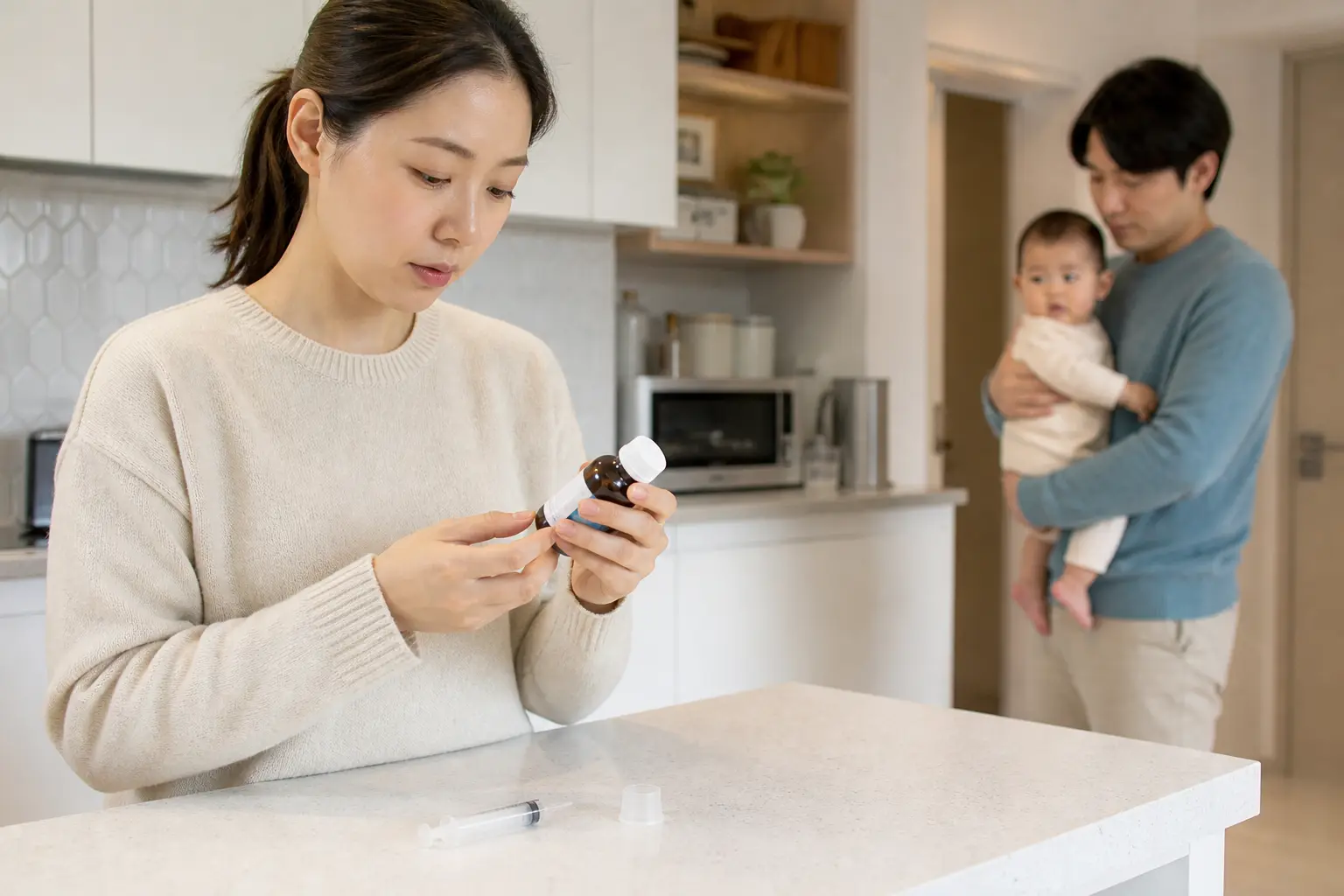
Most home dosing errors begin before the medicine reaches the baby: the wrong bottle, an unclear unit, a household spoon, an unrecorded dose, or a bottle left out for later. A fixed check-measure-give-log-lock sequence closes those gaps.
SUMMARY
Use only a medicine specifically recommended for the baby and follow the current label or prescription. Measure liquid in milliliters with its oral syringe, give slowly along the inside of the cheek while the baby is upright, record immediately, close the cap, and lock every medicine and supplement out of sight and reach. Never guess, double a dose, or combine products without checking active ingredients. Contact poison advice or emergency services immediately for a suspected exposure or severe symptoms.
Evidence anchors: This guide is anchored to FDA — Don't Guess, Read the Label · FDA — Cough and Cold Medicines for Children.
The five-link medication chain
This part of infant medicine dosing safety turns the goal into observable decisions. Focus on right baby, right medicine, right amount and unit, right time, and right record and storage. Each item should be checked in the setting where it actually occurs, with the baby supervised and the next action already decided.
- right baby
- right medicine
- right amount and unit
- right time
- right record and storage
Start with a baseline rather than a verdict. One observation rarely proves that something is normal or abnormal. Compare the current pattern with the baby's usual pattern, the surrounding conditions, and any recent change in feeding, sleep, environment, or caregiving. Write down what was directly seen before adding an interpretation. This separation between observation and interpretation makes a later conversation with another caregiver or pediatrician much more useful and reduces decisions driven only by memory or worry.
For this specific topic, convert the checklist into a closed loop: observe, compare with baseline, act once, document the result, and decide when to review it. That loop matters because use only a medicine specifically recommended for the baby and follow the current label or prescription. If the baby has a clinician-written plan, place that plan beside the checklist and note exactly where it changes the general sequence.
Why infants need a lower threshold
This part of infant medicine dosing safety turns the goal into observable decisions. Focus on small dosing margins, age restrictions vary, illness changes hydration and absorption, and individual prescriptions override general advice. Each item should be checked in the setting where it actually occurs, with the baby supervised and the next action already decided.
- small dosing margins
- age restrictions vary
- illness changes hydration and absorption
- individual prescriptions override general advice
Age and context change how the same signal should be read. A newborn has less physiologic reserve and a lower threshold for professional assessment than an older infant, while a mobile baby can reach hazards that previously seemed safely distant. Prematurity, chronic conditions, a recent illness, or a clinician's individualized plan may also change the safest action. Use this guide as an operating framework, then place the baby's own medical instructions above any general rule.
For this specific topic, convert the checklist into a closed loop: observe, compare with baseline, act once, document the result, and decide when to review it. That loop matters because use only a medicine specifically recommended for the baby and follow the current label or prescription. If the baby has a clinician-written plan, place that plan beside the checklist and note exactly where it changes the general sequence.

Read the label before measuring
This part of infant medicine dosing safety turns the goal into observable decisions. Focus on baby's name and medicine, concentration and active ingredient, dose unit and interval, and expiry and storage. Each item should be checked in the setting where it actually occurs, with the baby supervised and the next action already decided.
- baby's name and medicine
- concentration and active ingredient
- dose unit and interval
- expiry and storage
Prepare the environment before handling the baby or the task. Put the needed items within the adult's reach, remove distractions, and keep medicines, chemicals, cords, hot liquids, and small objects beyond the baby's reach and sight. If two adults are present, name who is responsible for the baby and who is responsible for the equipment. A clear handoff prevents the common moment when each adult assumes the other is supervising.
For this specific topic, convert the checklist into a closed loop: observe, compare with baseline, act once, document the result, and decide when to review it. That loop matters because use only a medicine specifically recommended for the baby and follow the current label or prescription. If the baby has a clinician-written plan, place that plan beside the checklist and note exactly where it changes the general sequence.
Measure in milliliters
This part of infant medicine dosing safety turns the goal into observable decisions. Focus on use the supplied oral syringe, match mL to mL, remove large air bubbles, and never use a kitchen spoon. Each item should be checked in the setting where it actually occurs, with the baby supervised and the next action already decided.
- use the supplied oral syringe
- match mL to mL
- remove large air bubbles
- never use a kitchen spoon
Work in a fixed sequence so that a tired caregiver does not have to improvise. Confirm the baby, item, instruction, and timing; complete one action; then close, clean, store, and document before moving on. If anything does not match, pause instead of guessing. A repeatable sequence is not bureaucracy: it is a practical defense against interruptions, sleep deprivation, and two caregivers unknowingly doing the same task.
For this specific topic, convert the checklist into a closed loop: observe, compare with baseline, act once, document the result, and decide when to review it. That loop matters because use only a medicine specifically recommended for the baby and follow the current label or prescription. If the baby has a clinician-written plan, place that plan beside the checklist and note exactly where it changes the general sequence.

Give liquid medicine safely
This part of infant medicine dosing safety turns the goal into observable decisions. Focus on hold the baby upright, aim along the inside of the cheek, give small portions slowly, and stop if breathing or alertness changes. Each item should be checked in the setting where it actually occurs, with the baby supervised and the next action already decided.
- hold the baby upright
- aim along the inside of the cheek
- give small portions slowly
- stop if breathing or alertness changes
A useful record is short enough to maintain and specific enough to guide action. Record the clock time, what happened, what was directly observed, what the adult did, and what happened next. Use exact units when a number matters and avoid labels such as ‘bad day’ without details. Trends become visible when the same fields are used consistently. Bring the record to appointments or read it aloud during a phone call so the clinician can ask focused follow-up questions.
For this specific topic, convert the checklist into a closed loop: observe, compare with baseline, act once, document the result, and decide when to review it. That loop matters because use only a medicine specifically recommended for the baby and follow the current label or prescription. If the baby has a clinician-written plan, place that plan beside the checklist and note exactly where it changes the general sequence.
Log immediately and prevent double dosing
This part of infant medicine dosing safety turns the goal into observable decisions. Focus on record before leaving the area, include dose, unit and time, one shared family log, and never repeat because you cannot remember. Each item should be checked in the setting where it actually occurs, with the baby supervised and the next action already decided.
- record before leaving the area
- include dose, unit and time
- one shared family log
- never repeat because you cannot remember
Review patterns at a planned time instead of reacting to every isolated event. Look for direction, duration, and function: is the pattern improving, stable, or worsening; how long has it lasted; and can the baby still feed, breathe comfortably, wake normally, and produce the expected wet diapers? These functional signs are often more informative than a single photograph or a caregiver's impression. When two adults disagree, return to observable facts and the baby's individualized plan.
For this specific topic, convert the checklist into a closed loop: observe, compare with baseline, act once, document the result, and decide when to review it. That loop matters because use only a medicine specifically recommended for the baby and follow the current label or prescription. If the baby has a clinician-written plan, place that plan beside the checklist and note exactly where it changes the general sequence.

Check active ingredients
This part of infant medicine dosing safety turns the goal into observable decisions. Focus on compare every active ingredient, avoid adult formulations, do not stack cold products, and ask a pharmacist when names differ. Each item should be checked in the setting where it actually occurs, with the baby supervised and the next action already decided.
- compare every active ingredient
- avoid adult formulations
- do not stack cold products
- ask a pharmacist when names differ
Avoid shortcuts that remove a safety layer. Do not estimate a dose, conceal a goodbye, cover ventilation, leave a hazardous product out for the next use, or assume that a wipe replaces handwashing. Do not use an image, social post, or another family's routine as a prescription for this baby. If instructions are unclear, the safe next step is to stop and confirm them with the responsible service, pharmacist, or pediatrician.
For this specific topic, convert the checklist into a closed loop: observe, compare with baseline, act once, document the result, and decide when to review it. That loop matters because use only a medicine specifically recommended for the baby and follow the current label or prescription. If the baby has a clinician-written plan, place that plan beside the checklist and note exactly where it changes the general sequence.
Lock storage at home and away
This part of infant medicine dosing safety turns the goal into observable decisions. Focus on original child-resistant container, high, locked, out of sight, bags and visitors' medicines included, and travel case locked after every use. Each item should be checked in the setting where it actually occurs, with the baby supervised and the next action already decided.
- original child-resistant container
- high, locked, out of sight
- bags and visitors' medicines included
- travel case locked after every use
Escalation should be decided before stress is high. Write down who to call during routine hours, who provides after-hours advice, and where emergency care is available. Call emergency services for severe breathing difficulty, blue or gray color, unresponsiveness, a seizure, collapse, or another immediately life-threatening change. For a young infant or a baby with a special medical plan, ask the pediatrician whether additional same-day thresholds apply.
For this specific topic, convert the checklist into a closed loop: observe, compare with baseline, act once, document the result, and decide when to review it. That loop matters because use only a medicine specifically recommended for the baby and follow the current label or prescription. If the baby has a clinician-written plan, place that plan beside the checklist and note exactly where it changes the general sequence.

Suspected exposure and urgent signs
This part of infant medicine dosing safety turns the goal into observable decisions. Focus on do not wait for symptoms after suspected ingestion, call local poison advice, call emergency services for breathing or consciousness changes, and bring the container. Each item should be checked in the setting where it actually occurs, with the baby supervised and the next action already decided.
- do not wait for symptoms after suspected ingestion
- call local poison advice
- call emergency services for breathing or consciousness changes
- bring the container
Communication works best when it is structured. Begin with the baby's age and relevant condition, state the current concern in one sentence, give the timeline, describe feeding, breathing, alertness, temperature when relevant, and wet diapers, then state what has already been tried. Ask the receiver to repeat back any instruction that includes a dose, time, return criterion, or emergency threshold. Record the name or role of the person contacted and the agreed next step.
For this specific topic, convert the checklist into a closed loop: observe, compare with baseline, act once, document the result, and decide when to review it. That loop matters because use only a medicine specifically recommended for the baby and follow the current label or prescription. If the baby has a clinician-written plan, place that plan beside the checklist and note exactly where it changes the general sequence.
Medication record template
This part of infant medicine dosing safety turns the goal into observable decisions. Focus on date and time, medicine and concentration, amount in mL, and giver and observed response. Each item should be checked in the setting where it actually occurs, with the baby supervised and the next action already decided.
- date and time
- medicine and concentration
- amount in mL
- giver and observed response
Revisit the system after a week and after any near miss. Keep the parts that were easy to follow, remove fields nobody uses, and strengthen the step where an interruption occurred. Store the checklist where the action happens, not where it looks tidy. The goal is not a perfect log or a perfectly controlled day. The goal is a reliable process that helps adults notice change, act safely, and seek the right level of help without delay.
For this specific topic, convert the checklist into a closed loop: observe, compare with baseline, act once, document the result, and decide when to review it. That loop matters because use only a medicine specifically recommended for the baby and follow the current label or prescription. If the baby has a clinician-written plan, place that plan beside the checklist and note exactly where it changes the general sequence.

Frequently asked questions
Do I need to record every detail?
No. Record the small set of facts that can change the next decision: time, direct observation, action, and response. A record that is too detailed is often abandoned.
What if two caregivers disagree?
Return to directly observed facts, the written instruction, and the baby's usual pattern. If the disagreement affects safety, pause and confirm the plan with the responsible professional.
Can a photo replace a written note?
A photo can support a timeline but should not stand alone. Add the time, lighting or conditions, what changed, and how the baby was functioning.
When should I call the pediatrician?
Call when the pattern is worsening, the baby cannot feed or wake as usual, breathing changes, wet diapers fall, or the individualized plan says to call. Ask your pediatrician about age-specific thresholds.
What belongs in an emergency plan?
Keep routine, after-hours, poison advice when relevant, and emergency contacts; the baby's key history; the exact location of supplies; and the signs that trigger each level of help.
Sources
This guide provides general education and does not replace diagnosis or an individualized plan from your pediatrician.