Newborn Jaundice: Observation and Care

Yellow skin can be a useful clue, but it cannot tell you the bilirubin level or whether treatment is needed. A newborn’s age in hours, a measured result, gestational age, feeding, weight, and overall condition turn a visual observation into a safe plan.
SUMMARY
Look in bright neutral light, including the eyes and gums, but treat appearance as a reason to measure rather than a measurement itself. Bilirubin results are interpreted against the baby’s age in hours and clinical risk. Jaundice noticed in the first 24 hours needs urgent assessment. Keep the agreed feeding plan, track feeds, wet diapers, stools, and wakefulness, and attend the scheduled recheck. Phototherapy uses controlled medical light; sunlight is not a safe substitute. Poor feeding, hard waking, unusual tone or cry, dark urine, pale stools, fever, or worsening yellow color needs prompt care.
Evidence anchors: American Academy of Pediatrics / HealthyChildren — Jaundice · NICE — Jaundice in newborn babies under 28 days
What bilirubin is and why newborns become yellow
Bilirubin is a yellow pigment produced when red blood cells are broken down. A newborn makes relatively more bilirubin and has a liver that is still becoming efficient at processing and excreting it. Before birth the placenta helps remove bilirubin; after birth the baby must take over. This transition explains why some degree of jaundice is common, but common does not mean that every level or timing is harmless. Bilirubin can rise faster or higher when blood-cell breakdown is increased, the baby is premature, bruising is present, feeding is not yet effective, or another medical condition affects processing or excretion.
Yellow color often starts around the face and may become more noticeable lower on the body, but this visual spread cannot provide a reliable number. Skin tone, room lighting, camera white balance, and the observer’s experience all affect what is seen. The safe framework separates detection from decision: appearance prompts attention, while a transcutaneous or blood bilirubin measurement, interpreted with the baby’s age and risk factors, guides follow-up and treatment.
Why looking is useful but never enough
Observation is still valuable. In bright neutral daylight, yellowing may be easier to notice in the skin, whites of the eyes, gums, or inside the mouth. On darker skin, the eyes and oral tissues can provide additional clues, although none replaces measurement. Photographs taken under warm lamps often exaggerate yellow, while blue light can hide it. Pressing the skin and judging the briefly pale area is also not a dependable bilirubin test. Families should use visual changes to decide when to contact a clinician, not to calculate a level or cancel a scheduled test.
The baby’s behavior is part of the same observation. Feeding stamina, the ability to wake for feeds, muscle tone, cry, wet diapers, stool transition, and weight trend can reveal whether jaundice is occurring alongside inadequate intake or illness. A baby can have an important bilirubin level before the yellow color looks dramatic. Conversely, a clearly yellow baby may still need measurement to learn whether the level is below, near, or above an age-specific treatment threshold. The uncertainty is exactly why standardized measurement and follow-up exist.
A bilirubin number needs the baby’s age in hours
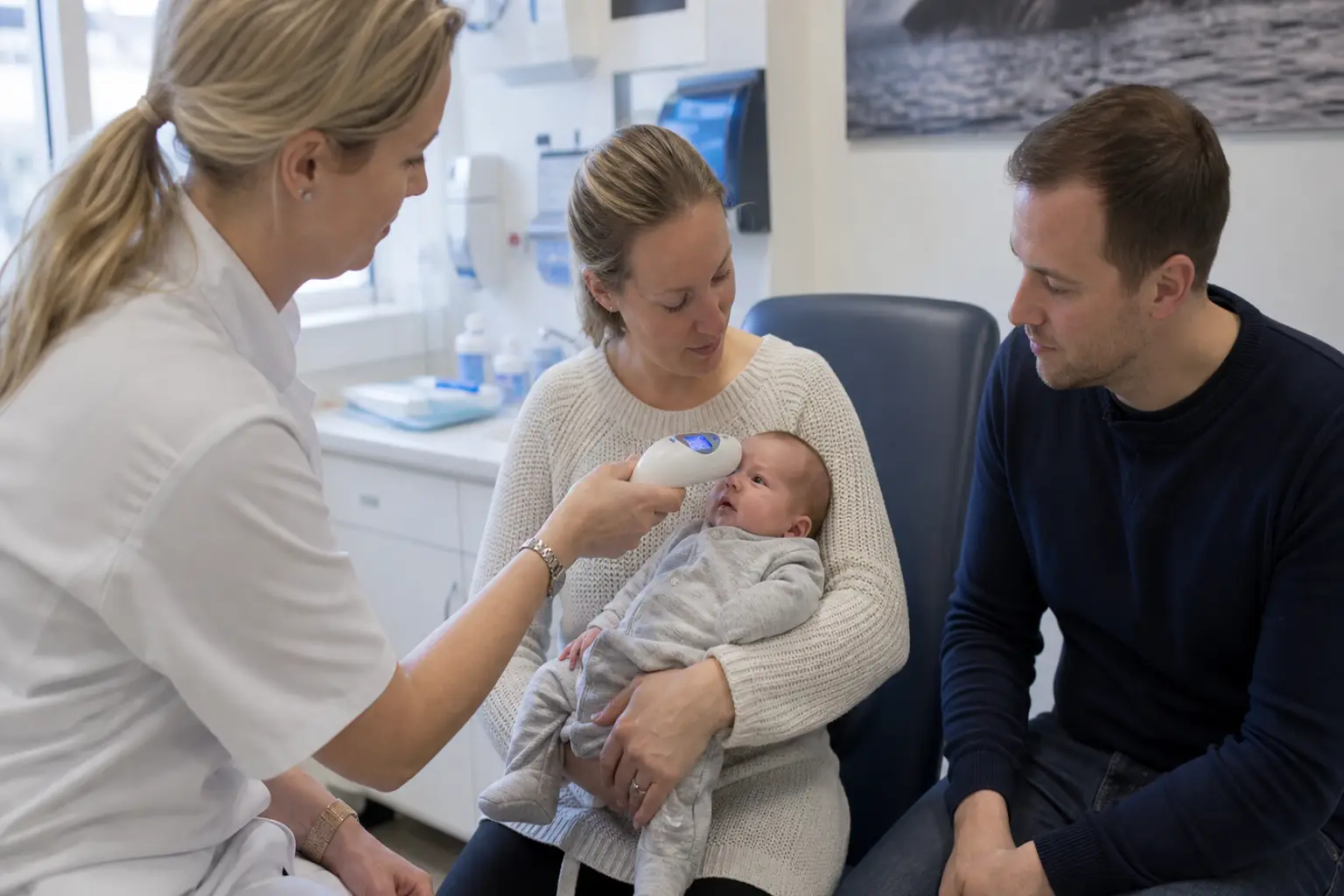
A result such as ‘12’ has no safe meaning by itself. Clinicians plot or calculate the value against the baby’s exact age in hours, then consider gestational age and factors that increase the risk of bilirubin affecting the nervous system. The treatment threshold changes as the baby gets older. A value that requires urgent action early may be managed differently later. Ask for the number, the units, whether it came from a skin device or blood sample, the age in hours at measurement, and the time and place of the planned recheck.
A transcutaneous device estimates bilirubin through the skin and is useful for screening. A blood test may be required to confirm a result, especially near a treatment threshold or when clinical circumstances warrant it. These tests are not competing opinions; they form a pathway. A result should also be linked with discharge timing. Bilirubin can continue to rise after a family goes home, so the distance from the treatment threshold and the baby’s feeding and risk profile help determine how soon follow-up is needed.
Jaundice in the first 24 hours changes urgency
Visible jaundice during the first 24 hours after birth is not treated as routine physiologic jaundice. It needs urgent bilirubin measurement and medical evaluation because early onset can reflect increased red-cell breakdown, blood-group incompatibility, infection, or another condition. Do not wait for the next routine visit or brighter yellow color. Tell the birth service or pediatric team exactly when the color was first noticed and whether the baby is feeding, waking, and maintaining normal temperature.
Other factors can lower the threshold for closer monitoring: prematurity, a previous sibling who required phototherapy, significant bruising or a scalp blood collection, blood-group or antibody concerns, enzyme conditions such as G6PD deficiency, illness, and feeding difficulty. Family ancestry and history can matter for some risks, but they are not substitutes for testing. The purpose of listing risks is not to predict an outcome at home. It is to make sure the measured result is interpreted with the correct clinical context and the recheck is timed safely.

Feeding and jaundice influence each other
In the first days, ineffective milk transfer or intake can reduce stooling and increase bilirubin reabsorption from the intestine. A sleepy jaundiced baby may then feed less effectively, creating a cycle that needs early support. The response is not simply to stop breastfeeding or force a large volume. A clinician or lactation professional can observe a feed, assess latch and swallowing, review frequency and supplementation indications, and connect those findings with weight, hydration, and bilirubin. Most jaundiced newborns can continue breastfeeding with an individualized plan.
Later, some thriving breastfed infants have prolonged unconjugated jaundice associated with breast milk. That pattern is considered only after feeding adequacy and other causes are assessed; it should not be self-diagnosed from duration alone. Formula-fed and mixed-fed babies can also develop jaundice. What matters is the baby’s actual transfer and intake, not the feeding label. Never dilute or concentrate formula, add unprescribed ingredients, or give water to lower bilirubin. Any supplementation should use a safe preparation method and a plan that protects both the baby and, when relevant, milk supply.

Outputs and weight make feeding observations more useful
A feed log becomes clinically useful when it includes start times, approximate duration or measured volume when known, swallowing or fatigue, and whether the baby wakes independently or must be roused. Wet diapers and stools add trend information, but a single diaper cannot prove hydration. Stool normally changes after birth, and bilirubin leaves the body through stool. Delayed transition or unexpectedly few outputs can support concern about intake, while exact expectations vary with age and feeding circumstances. Use the targets provided by the birth team rather than an isolated online chart.
Weight change completes the picture. Newborns normally lose some weight after birth, but the amount, trajectory, measurement method, and recovery need clinical interpretation. Different scales, clothing, and timing can create small differences. Bring the birth weight, discharge weight, later measurements, and where each was taken. When a jaundiced baby is hard to wake, feeds poorly, or has fewer outputs than the agreed expectation, contact the care team promptly instead of waiting for the next scheduled weigh-in.
Discharge follow-up is part of care, not an optional extra
Before leaving the birth facility, families should know whether bilirubin was measured, the result and time, what the value means for this baby, and when follow-up will occur. The appointment may be soon because bilirubin often peaks after discharge. A plan that says only ‘watch for more yellow’ is incomplete if the measured result, gestational age, feeding, or risk factors call for a timed recheck. Confirm who will perform the test and what to do if the clinic is closed, transportation fails, or the baby’s condition changes first.
At home, use the same neutral light when possible and note the direction of change, but do not use phone applications or photographs as replacements for a validated test. Keep the discharge sheet accessible. Record feeds, outputs, alertness, temperature when indicated, and any new vomiting or illness. The goal is not continuous surveillance. It is to arrive at the planned review with a short, accurate trend and to recognize changes that should move the review earlier.
Phototherapy is controlled medical treatment
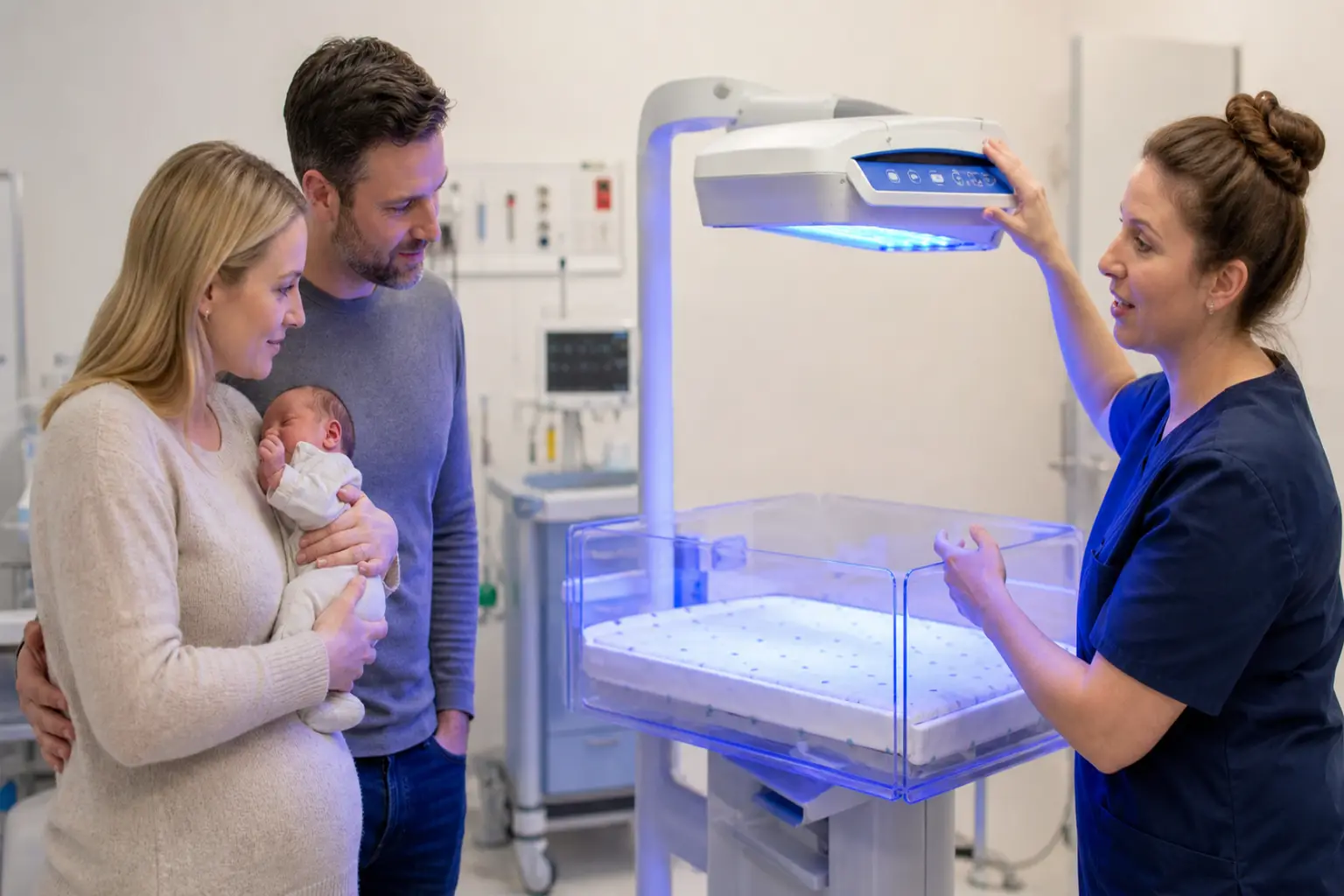
Phototherapy exposes the baby to specific wavelengths of light that change bilirubin into forms the body can eliminate more readily. Dose depends on the light spectrum, intensity, distance, and exposed surface area, which is why a hospital unit or prescribed home device is managed carefully. Eye protection, temperature, hydration, feeding, bilirubin checks, and breaks are coordinated by the clinical team. The blue appearance of the lamp is not what makes any blue light equivalent treatment.
Sunlight is not a safe substitute. Its bilirubin-effective dose is unpredictable, while ultraviolet exposure, overheating, chilling near a window, and delayed effective treatment create risk. Placing a newborn in direct sun or undressing the baby by a window should not be used as home phototherapy. If treatment is recommended, ask how feeding will continue, when levels will be rechecked, what rebound follow-up is planned, and which signs require immediate contact. Phototherapy is usually effective, but it must be connected to measurement rather than appearance alone.
Prolonged jaundice and stool or urine color
Jaundice that lasts longer than expected needs review according to gestational age and local guidance. Many causes are benign, but clinicians may need to distinguish unconjugated bilirubin patterns from cholestasis, where bile flow is impaired. Pale, chalky, gray, or white stools and urine that is persistently dark enough to stain the diaper are important clues. Normal newborn urine may be concentrated early, and stool colors vary, so take a photograph in neutral light and contact a clinician rather than relying on a color name alone.
Do not wait for the baby to appear very ill if stools lose their normal pigment. Conditions affecting the liver or bile ducts, including biliary atresia, benefit from early recognition. Also report poor growth, swelling, unusual bleeding or bruising, fever, vomiting, or a change in behavior. Testing may include different bilirubin fractions and other investigations. This is not a reason to order commercial tests independently; it is a reason to bring the duration and color pattern to pediatric care promptly.

Changes that should not wait for a routine recheck
Seek prompt medical assessment for jaundice in the first day, rapidly increasing yellow color, poor feeding, repeated vomiting, fewer outputs than the baby’s plan, fever or low temperature, or a baby who is increasingly sleepy. Emergency help is appropriate for a baby who is very hard to wake, has abnormal stiffness or floppiness, a high-pitched unusual cry, breathing difficulty, pauses, seizure, collapse, or blue or gray color. Do not spend time trying sunlight, adding feeds without a safe plan, or taking repeated photos when the baby’s responsiveness is changing.
When calling, state the exact age, gestational age, birth and discharge dates, bilirubin number and units, age in hours at the test, feeding method and recent intake, wet diapers and stools, weight history, temperature and method, and the change that prompted the call. Bring the discharge record. This concise information lets the clinician connect observation with an age-specific measurement. The core principle is simple: yellow color opens the question; timed testing, feeding assessment, and the baby’s overall condition answer it.
Frequently asked questions
Can I estimate bilirubin from a photo?
No. A photo can document change but cannot replace a transcutaneous or blood measurement interpreted by age in hours.
Should breastfeeding stop?
Usually not. Continue the individualized feeding plan and obtain early help with transfer, intake, weight, and any indicated supplementation.
Can sunlight treat jaundice?
No. Sunlight is unpredictable and adds ultraviolet and temperature risks. Use prescribed medical phototherapy when treatment is indicated.
Why is a recheck needed after discharge?
Bilirubin can continue rising after discharge. Timing depends on the measured value, age in hours, gestational age, feeding, and risk factors.
Which stool color needs prompt advice?
Pale, chalky, gray, or white stools need prompt clinical review, especially with prolonged jaundice or dark urine.
Sources
This guide provides general education and does not replace diagnosis or an individualized plan from your pediatrician.