Baby Dark Yellow Urine Check
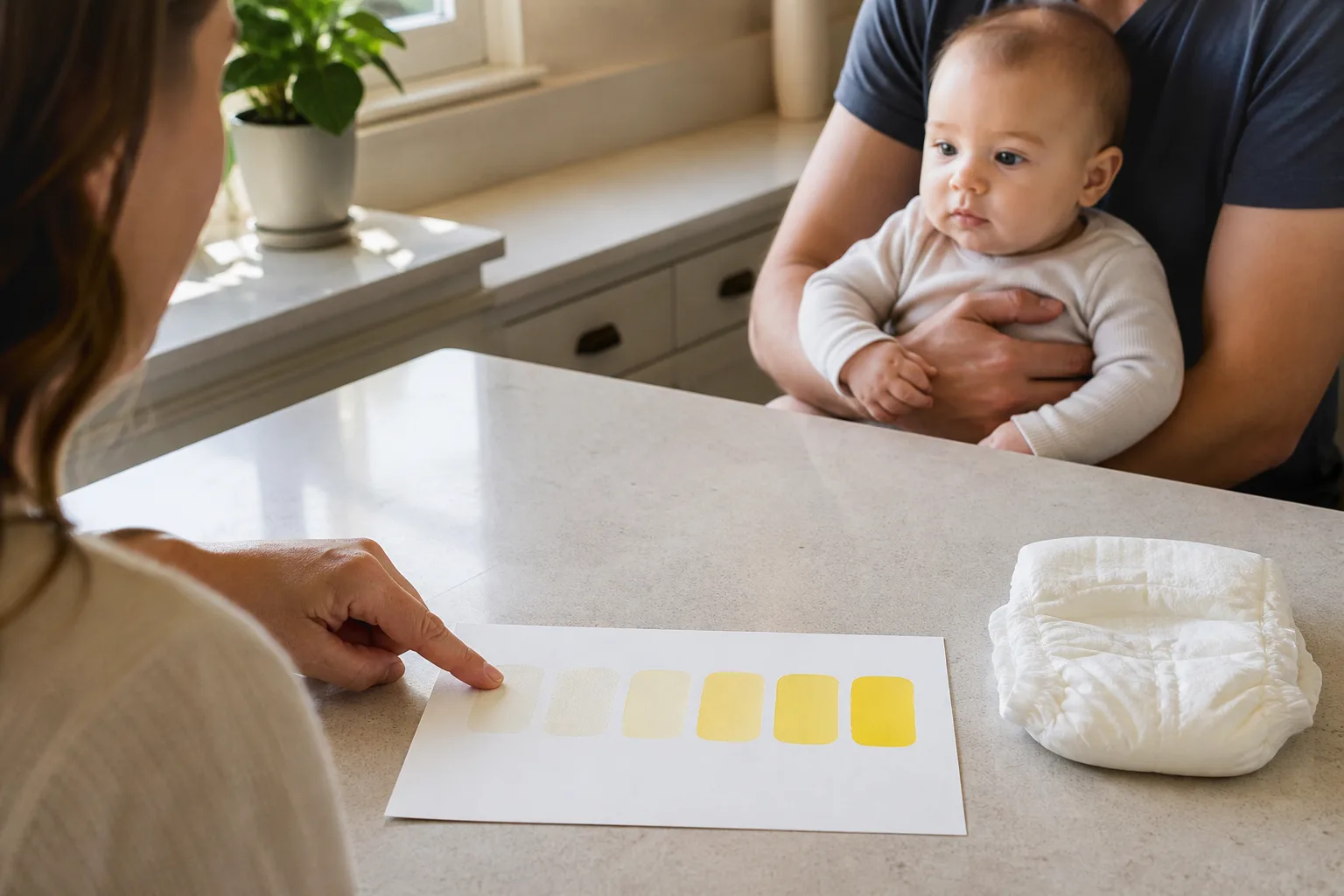
One darker patch does not prove dehydration. Check whether the diaper was left longer, how the absorbent layer changes color, and whether urine output, feeding, mouth moisture, tears, and alertness have changed together.
SUMMARY
Dark yellow urine can be more concentrated, but diaper materials, lighting, and time since the last change can alter its appearance. Compare several diapers and your baby's normal output. If darker urine comes with fewer wet diapers, dry mouth, few tears, poor feeding, or unusual sleepiness, contact your pediatrician promptly.
Start with age and the usual pattern
The first question is not simply how many diapers appeared. Start with color in context. A newborn in the first days after birth has a changing pattern, while an older infant has an established personal baseline. Count across a full 24 hours when there is no emergency. Write the time of each clearly wet diaper. Compare the total with recent days, not with a single memory from a stressful night. Disposable diaper absorbency can hide small amounts, so a noticeably heavier diaper is more useful than the color of an indicator line alone. A change is more meaningful when it is repeated or accompanied by another symptom.
Use the number as a clue, not a diagnosis
A practical review centers on several diapers rather than one. During the first days, output generally rises as milk intake increases. By about day five, six or more wet diapers in 24 hours is commonly used as a reassuring sign for a breastfed newborn. That number is not a guarantee and it is not a universal prescription. Prematurity, illness, a clinician-directed feeding plan, and the exact day of life can change expectations. If your maternity or pediatric team gave a specific plan, use that plan. Ask your pediatrician when the pattern is unclear rather than trying to correct a low count with plain water.
Check feeding at the same time
Diaper output makes more sense beside feeding and output together. Record when the baby fed, whether sucking and swallowing seemed effective, and whether the baby stayed alert enough to feed. For bottles, write the approximate amount offered and taken without pressuring the baby to finish. For breastfeeding, record the start time, approximate duration, side changes, and what you can observe; do not invent a milk volume. Repeated refusal, a much shorter or weaker feed, repeated vomiting, or difficulty waking changes the level of concern. Feeding and urine can fall together when an infant is becoming dehydrated.

Look beyond the diaper
The American Academy of Pediatrics lists reduced urination with a dry mouth, fewer tears, a sunken soft spot, unusual sleepiness, or irritability among dehydration clues. The NHS also advises watching for fewer wet diapers, drowsiness, fast breathing, and a sunken soft spot. No single clue should be interpreted without context, but several changes together deserve prompt medical advice. Look at the baby before looking at the record: breathing, skin color, responsiveness, and ability to feed can make the situation urgent even when the exact diaper count is uncertain.
Respond safely while you reassess
Continue breast milk or correctly prepared infant formula according to the baby's normal feeding plan unless a clinician tells you otherwise. Do not dilute formula and do not give extra plain water to an infant under six months as a home treatment. The AAP and WHO describe breast milk or formula as the main hydration source in early infancy. If vomiting or diarrhea is present, the appropriate replacement plan depends on age and symptoms. Call a clinician for instructions instead of guessing at volumes or changing formula concentration.
Know when to call
Use symptom clusters rather than waiting for certainty. The AAP symptom guidance treats no urine for more than eight hours, very low intake, or a very dry mouth as reasons for prompt contact. Call sooner for a young newborn or when your baby has a medical condition or a clinician-directed plan. Seek emergency help now for severe breathing difficulty, pauses in breathing, blue or gray color, marked limpness, a seizure, or difficulty waking. A record supports the call, but completing a log must never delay urgent care.
Make the record useful
A useful note includes the baby's age, the last clearly wet diaper, the count during the previous 24 hours, recent feeds, stools, vomiting or diarrhea, measured temperature, tears, mouth moisture, and alertness. Mention any change from baseline and any recent illness or heat exposure. Photographs are rarely necessary, and generated color charts can mislead because screens and lighting vary. Plain observations are more reliable: pale or dark, small or usual amount, and whether the pattern repeated. Bring this concise summary to the pediatrician.
Avoid common counting mistakes
Do not count a diaper only because its wetness indicator changed. Do not compare a thin newborn diaper with a larger overnight diaper as if their absorbency were identical. Avoid resetting the count at midnight if a rolling 24-hour view would show the trend more clearly. Do not treat one stool-heavy diaper as proof that urine was adequate when you could not tell. Most importantly, do not wait for a target number if the baby looks unwell. Whole-body condition always outranks a tidy spreadsheet.
Frequently asked questions
Can one wet diaper rule out dehydration?
No. Use the full-day trend, feeding, and whole-body signs.
Should I give water to fix a low count?
Not to an infant under six months unless a clinician specifically directs it. Ask your pediatrician.
Can I wait until the log is complete?
No. Emergency signs or a clear contact threshold take priority over documentation.
Sources
This article provides general information and is not medical advice. Ask your pediatrician about reduced urine, feeding concerns, or guidance tailored to your baby.